
The Financial Reset Button
Imagine your credit score is a financial report card, but right now it looks like you slept through the semester. It’s frustrating when a low score keeps you from getting that car, the apartment, or even a dream job. But here’s the truth we rarely hear: a low score is not a life sentence; it’s just a snapshot of your past. The good news is that credit bureaus are forgiving. They care more about where you’re going than where you’ve been.
In this guide, we are not just going to say “time heals your credit.” We’re going to show you actionable steps for rebuilding credit fast, often seeing results in as little as 30 to 60 days. If you have ever wondered what the fastest way to rebuild credit is, you’re in the right place.
The “Credit Myth Mega-Thread” (Stop Believing These Lies!)
Before we fix the engine, we have to stop putting the wrong fuel in the tank. There’s a lot of bad advice floating around that keeps people stuck. Let’s clear the air with a mini “Credit Myth” mega-thread.
Myth 1: “Checking my score lowers it.”
This is the granddaddy of all myths. When you check your own credit on sites like Credit Karma, AnnualCreditReport, or your bank’s app, it’s a soft inquiry. Soft inquiries do not affect your score. Only when a lender checks (a hard inquiry) could you see a tiny, temporary dip.
Myth 2: “I need to carry a balance to build credit.”
This myth costs Americans millions in unnecessary interest. You do not need to pay interest to build credit. In fact, paying interest does not help your score. FICO® and Experian experts agree: carrying a balance and paying interest is a waste of money. Simply use your card and pay the statement balance in full by the due date each month – you’ll report positive usage and pay zero interest. Treat it like a debit card with benefits.

Myth 3: “Closing old accounts helps my score.”
If you pay off a credit card, you might want to close it so you won’t be tempted. Do not do it! Closing an account reduces your total available credit, which can skyrocket your credit utilization ratio, and it shortens your credit history. Both factors hurt your score. Experts say keep old accounts open (maybe with a small recurring purchase) to maintain credit history and a low utilization rate.
Myth 4: “Rebuilding takes years.”
While a bankruptcy or foreclosure stays on record for years, rebuilding credit fast is absolutely possible. Scoring models heavily weight recent activity. You can see significant gains in 60 to 90 days if you are aggressive and consistent.
How Do You Begin to Repair a Low Credit Score? (The Blueprint)
So, how do you begin to repair a low credit score? You don’t start with a new loan. You start with a diagnosis. You wouldn’t ask a doctor for medicine before taking an X-ray, right?
Step 1: The AnnualCreditReport.com Power Move
Go to AnnualCreditReport.com, the only government-authorized site for free credit reports. (Thanks to new laws, everyone now gets weekly free reports from Equifax, Experian, and TransUnion.) Pull all three. You are looking for errors – accounts you didn’t open, late payments that are actually on time, wrong balances, etc. According to the CFPB, “one in five people have an error on at least one of their credit reports”. Those errors could be dragging down your score.
Step 2: The 30-Minute Dispute
If you find errors, dispute them immediately online with the credit bureaus. Correcting a late payment error is arguably the fastest way to rebuild credit, because it removes a negative instantly instead of waiting for positive activity to outweigh it. (You can dispute on each bureau’s site or use sample letters from CFPB.) Remember: errors on your report can lower your score, so fixing them can give you a quick boost.
The “Credit Score from 500 to 700” Strategy
Jumping from a 500 to a 700 isn’t magic; it’s math. A FICO® Score is made of five categories. To make the big jump from 500 to 700, you must target the heaviest weights:
- Payment History (35%) – Pay everything on time, always.
- Credit Utilization (30%) – How much of your credit you use.
- Length of History (15%) – How old your accounts are.
- Credit Mix (10%) – Ratio of cards to loans.
- New Credit (10%) – Recent inquiries and accounts.
To move the needle fast, attack Payment History and Utilization together.
The “AZ” Method for Utilization
Let’s say you have a credit card with a $500 limit. If you spend $450, your utilization is 90% – a big red flag. To go from a credit score of 600 to 700+, you need the “AZ” (Always Zero) method. Don’t just pay by the due date – pay before the statement closing date, so the reported balance is near zero. For example, if your statement date rolls at $0, utilization is 0%. Even $5 is just 1%. Both are excellent, but we aim to keep utilization under 10%. (Experts recommend under 30%, but <10% is ideal for top scores.)
Pro Tip: Make multiple small payments each month. For instance, buy something on Day 1 and pay it off on Day 2 consistently. This triple-play payment strategy keeps your balance essentially at zero while logging frequent on-time payments. Paying before the statement closes is key to fast improvement.
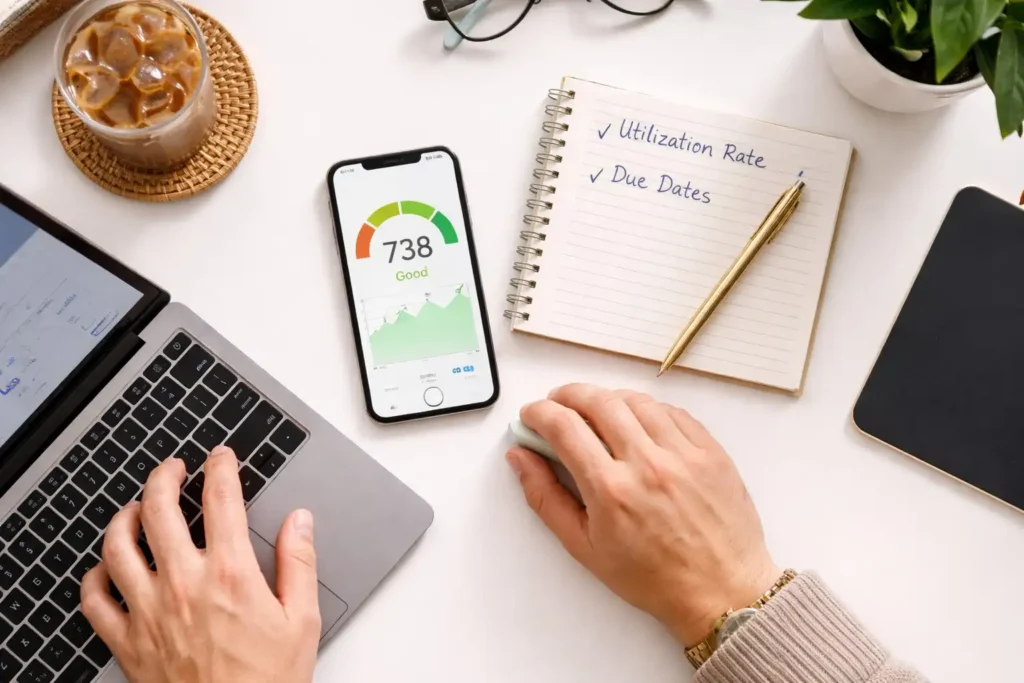
The 60-Day Game Plan for Rebuilding Credit in 60 Days
Is rebuilding credit in 60 days realistic? Yes! But you have to be aggressive. You won’t just sit and wait; you’ll force your score to move.
Week 1–2: Secured Cards and Authorized User Status
If your credit is damaged, you won’t qualify for premium cards yet. Start with a secured credit card. You deposit (say) $200, and the bank gives you a $200 limit. Use it for small purchases (gas, groceries, Netflix), then pay it off immediately each time. This on-time usage reports positively. Bankrate notes that “using your secured credit card responsibly, including keeping your balance low and making on-time payments, will help you build a positive credit history.”.
At the same time, ask a family member or close friend with excellent credit to add you as an authorized user on their oldest credit card (they don’t even have to give you the card physically). You’ll inherit their positive payment history on that account, which can give you an instant boost. In fact, Bankrate says you might see your score change “as soon as the lender starts reporting that information – which can take as little as 30 days.”. (Just be sure they keep that account in good standing!)
Week 3–4: The Credit Builder Loan
While your secured card reports, consider a credit-builder loan at a local credit union or community bank. Experian explains these as installment loans where you “borrow” a small amount that the bank holds in a savings account. You make fixed monthly payments (with interest) for, say, 6–12 months, and the bank releases the money to you at the end. Each on-time payment is reported to the bureaus, building your payment history. This is like forced savings and adds a diversity of credit (installment credit vs. revolving). Experian notes this strengthens your credit with “on-time monthly payments” and builds a positive payment history, which is 35% of your score.
Week 5–8: The “Triple Play” Payment
Here’s the secret sauce for rebuilding credit to 750. Don’t wait for the statement cut-off to pay. Instead, every time you charge something:
- Buy something on Day 1.
- Pay it off on Day 2.
- Repeat weekly.
This keeps your utilization at nearly 0% but floods your credit report with on-time payment activity. It’s the fast way to rebuild damaged credit because it rapidly replaces old negatives with fresh positives.
Realistic Timelines (What to Expect)
Let’s look at the calendar. What progress can you expect if you execute this playbook?
Month 1: The Foundation
Score Impact: +20 to +40 points (varies by individual).
What’s happening: Your new secured card account reports to the bureaus. You may see a bump from its positive history. (Hard inquiries from any applications might cause a small, temporary dip, but that fades quickly.) You have officially started rebuilding your credit fast.
Month 2: The Momentum
Score Impact: +30 to +60 points (cumulative).
What’s happening: Your authorized user account should now be on your report, adding age and positive payments to your file. Your utilization is rock-bottom, thanks to the AZ method and triple-pay strategy. You are likely moving from “Poor/Fair” into the “Fair/Good” range. Many people see that jump from the 600s into the high 600s or 700+ by this point.
Month 3–6: The Cruise Control
Score Impact: Potential total gain of +100+ points.
What’s happening: Time is on your side. The age of your credit accounts grows, and the negative marks from the past are diluted by the volume of new positive payments. You might qualify for an unsecured credit card now. By following this plan, you’re well on your way to rebuilding credit to 750 and beyond.
Experian confirms: paying off revolving debt can improve your score in 1–2 months, and consistent on-time payments can boost your score steadily over time. So stick with the plan – the results compound.
Related Stories from TheFitFinance
Bank Loan Exit Strategy: How to Escape Debt Faster (2026 Guide)
How to Pay Off Credit Card Debt Fast: 11 Proven Ways to Get Debt-Free Quickly
Average IQ of Poor People: The Real Science Explained (16 Min. Read)
Exploding Credit Card Debt Crisis in America: Causes, Consequences, and Solutions
Advanced Tactics for Stubborn Scores
Sometimes you do everything right and the score still seems stuck. Here’s how to troubleshoot:
Experian Boost and UltraFICO
Use every free tool you can. Experian Boost® allows you to add utility, phone, and even streaming payments (like Netflix) to your credit file. You connect your bank, it finds qualifying bill payments, and “adds them to your Experian credit file”. Experian boasts that Boost “can increase your credit scores fast” for free.
Similarly, UltraFICO™ lets you add banking data (savings/checking) to your FICO score. Experian reports that “7 out of 10 U.S. consumers who exhibit responsible financial behavior in their checking and savings accounts could improve their score with an UltraFICO Score.”. If you have stable positive balances, these tools can give your score a lift in minutes.
The Goodwill Letter
If you have one old late payment from years ago (say a missed bill due to an emergency), try a goodwill letter. This is a polite, written request to the creditor asking them to remove the mark as a courtesy. Bankrate explains that a goodwill letter “may allow you to correct a one-time mistake, reversing the damage done to your credit by a missed payment”. It works more often than you might think if the rest of your history is clean. (No guarantees, but it’s free credit repair!)
The Interactive Element: The “Rebuilder” Self-Assessment
Before you go, make sure you’re on the right track. Answer these Yes/No questions:
- The Error Hunt: Have you checked all three credit reports for errors in the last 30 days? (Yes/No)
- The Utilization Check: Is your credit card balance below 10% of your limit right now? (Yes/No)
- The Payment Record: Have you paid every single bill on time for the last 60 days? (Yes/No)
- The Mix: Do you have at least one revolving account (credit card) and one installment account (loan) reporting? (Yes/No)
If you answered “No” to any of these, scroll back up and tackle that section first. That is your fastest path to improvement. These are the fundamentals of rebuilding credit fast – fix errors, cut utilization, show on-time payments, and diversify your credit.

Conclusion: Your Future Self is Thanking You
Rebuilding your credit is not just about a number. It is about the interest rate you will get on your first home, the deposit you won’t have to pay on an apartment, and the peace of mind that comes with financial flexibility. The fastest way to rebuild credit isn’t a secret hack; it’s consistency. It’s paying that card off every week. It’s checking your report every month. It’s a boring, beautiful marathon that ends with you holding the keys to your new life.
You have the roadmap for rebuilding credit fast. Now, take that first step.
Call to Action: I want to hear your wins! Have you tried any of these methods? Did you find a nasty error on your report? Drop a comment below and let me know – I read every single one. And if this helped, share it with a friend who needs to see it.
Punchy Line: Just like we mapped out your journey to a million-dollar net worth last week, think of this as clearing the weeds from the path so you can actually enjoy the walk.