

Meet Jordan, a 32-year-old who feels stuck in a financial rut. Every paycheck seems to vanish within days. Rent, bills, a few takeouts, poof – it’s gone. Saving for the future? Forget it. And investing, like buying stocks or emerging markets funds? That sounds like something only “rich people” do when they have extra cash lying around. Jordan is working hard yet treading water, wondering why building wealth is so darn hard.
Here’s a secret: The issue often isn’t how much you earn – it’s how you spend. Bad spending habits are the silent leaks in your financial boat. You can’t build a solid wealth portfolio (say, one that even taps into exciting emerging markets) if you are constantly bailing water to stay afloat.
The good news? You are about to plug those leaks. In this ultimate guide, we’ll start with a step-by-step “spending detox” to fix those bad spending habits once and for all. Then, once your financial foundation is solid, we will show you how to confidently build your investing future – including making sophisticated concepts like emerging markets easy and actionable. Ready to fix your financial foundation so you can finally start building your investing future? Let’s dive in.
Your Money Is Talking-Are You Listening? The 5 Most Common Bad Spending Habits
Bad Habit #1: Lifestyle Creep – The Silent Salary Eater
What it is: Lifestyle creep (aka lifestyle inflation) is the sneaky habit of spending more whenever you earn more. Remember how you managed on your old salary? Yet after a raise or bonus, suddenly that extra cash “needs” to be spent – a nicer apartment, the latest phone upgrade, more dinners out. It’s like your expenses have a rubber-band effect, always stretching to gobble up that new income.
Why it happens: Psychologically, it often comes from a sense of deserving a better life when you make more. But without conscious spending, those small upgrades add up fast. One day you’re wondering, “How am I still living paycheck to paycheck on a higher income?” That’s lifestyle creep. In fact, about 54% of Americans live paycheck to paycheck overall, and even 40% of those earning six figures do too – often thanks to lifestyle inflation.
Cure bad spending habit #1:
• Automate Your Raises to Savings: The moment you get a raise, pretend you didn’t. Increase your 401(k) contribution or automatic transfer to savings/investments by the raise amount. If you never see the extra money, you won’t miss it.
• Audit Your Upgrades: Before upgrading your lifestyle (new car, bigger home, pricey gadget), ask: If I was broke, would I still find a way to afford this? If the answer is no, it’s probably a want, not a need. Prioritize what truly adds value to your life and delay the rest.

Bad Habit #2: Impulse Buying – The “Treat Yourself” Trap
What it is: Ever gone into Target for toothpaste and left with a cart full of “extras”? That’s impulse buying. It’s the oh-so-tempting habit of instant gratification purchases – unplanned snacks, flash sale gadgets, the late-night Amazon spree. Impulse buys are like financial mosquito bites: itchy satisfaction in the moment, but later you’re left scratching your head wondering where your money went.
Why we do it: Blame fatigue, stress, or clever marketing. After a long day, your brain says “I deserve this!” when you see something shiny on sale. Emotions (boredom, sadness, even excitement) often trigger mindless spending before logic kicks in. And the stats are eye-opening: the average American spends around $300 a month on impulse purchases – over $3,000 a year on stuff that wasn’t in the plan. In fact, 1 in 6 Americans spends more on impulse buys than on retirement savings. Yikes!
Cure bad spending habit #2:
• Stick to a 48-Hour Rule: See something you want? Give it 48 hours. Often, the impulsive urge will pass (and you’ll realize you didn’t truly need another gadget or pair of shoes).
• Shop with a List (and Budget): Whether at the store or online, write a list and stick to it. Set a spending limit. If it’s not on the list, it can wait. Apps can help by flagging unplanned purchases and forcing a pause before checkout.
Bad Habit #3: Emotional Spending – Retail Therapy Gone Rogue
What it is: Emotional spending (a.k.a. “retail therapy”) is using shopping as a mood booster. Feeling down, stressed, or even celebrating? You swipe your card to chase a dopamine hit. Buying new clothes when you’re sad, ordering fancy takeout when you’re anxious, splurging online out of boredom – it’s spending driven by heart, not head.
Why we do it: Emotions can overpower logic. In tough times, shopping feels like self-care – a quick pick-me-up for a bad day. And our culture normalizes it (“Treat yo’ self!”). But when the high fades, the bills remain. A survey found 63% of Americans admit emotions influence their spending. Worse, 74% of those shoppers say it led to overspending. It often becomes a vicious cycle: stress leads to spending, which leads to financial stress.
Cure bad spending habit #3:
• Find a Feel-Good Substitute: Identify non-spending ways to boost your mood. Go for a run, call a friend, play with your dog, or watch a favorite movie. Have a go-to list of activities that make you feel good without costing money.
• Use the 24-Hour Rule: If you’re about to buy something because you’re emotional, pause and wait 24 hours (or at least overnight). This cool-off period separates genuine needs from mood-driven wants. Most of the time, you’ll find the urge melts away – and you just saved your wallet from a regretful purchase.
Bad Habit #4: No Budget, No Plan – Flying Blind Financially
What it is: This habit is less about what you buy and more about not knowing where your money goes. It means living without a budget or spending plan – essentially flying blind with your finances. You swipe your card, pay bills as they come, and hope for the best. The result? You’re often shocked by a low bank balance and wondering, “Where did my paycheck go?!”
Why it’s a problem: Without a plan, small leaks go unnoticed – unused subscriptions, random takeouts, little fees slip through the cracks. Many people think budgets are restrictive, but a budget is really just a money map, telling your dollars where to go instead of wondering where they went. No wonder 83% of Americans say they overspend (and even those with budgets often blow past them). If you don’t track it, you can’t improve it.
Cure bad spending habit #4:
• Start a “No-Judgment” Budget: For one month, track every expense without trying to change anything, just to see where your money actually goes. Then draft a simple budget that covers essentials, sets aside savings/investments, and even allocates some fun money (you’re allowed to enjoy life!). Apps like Mint or YNAB can make tracking easier.
• Pay Yourself First: Treat your future like a must-pay bill. Automate a transfer to your savings or IRA right after payday, before you have a chance to spend it. This builds the habit of prioritizing your goals before discretionary splurges.
Bad Habit #5: Keeping Up with the Joneses – Spending for Appearances
What it is: This is classic peer-pressure spending. You feel compelled to match your lifestyle to those around you (friends, family, even strangers on Instagram). If your neighbor buys a new car, suddenly your perfectly fine car feels inadequate. If your friends book a luxury vacation or hit pricey brunch spots every weekend, you say yes to avoid feeling left out – even if it strains your budget. It’s spending to keep up rather than based on what you value.
Why we do it: FOMO (fear of missing out) and social pressure are powerful – we all want to belong. Advertisers and influencers know this, constantly showing off the latest “must-haves” and equating spending with status. In one survey, 21% of Americans felt pressured to spend to keep up with others. That social pull can easily tempt us into spending for show instead of for our own needs.
Cure bad spending habit #5:
• Revisit Your Priorities: Write down your top financial goals (buying a home, traveling, debt-free living, etc.). When you know your why, it’s easier to say “no” to expenses that don’t serve those goals. Your friends’ priorities might differ – and that’s okay.
• Practice Gratitude (and a Social Media Detox): Regularly remind yourself of what you already have. Gratitude curbs the urge to constantly upgrade for appearances. And if Instagram or TikTok triggers your spending envy, take a social media break or unfollow accounts that crank up the FOMO. (Out of sight, out of mind!)
What’s Your Financial Kryptonite? (90-Second Quiz)
Answer each question with a simple “Yes” or “No.” Give yourself 1 point for each “Yes”:
1. Lifestyle Creep: In the last year, did an increase in your income somehow vanish with higher spending (e.g., you got a raise or bonus but still ended up with no extra savings)?
2. Impulse Splurges: Do you often buy things on a whim – grabbing items not on your shopping list or clicking “Buy Now” on deals, only to later wonder why?
3. Retail Therapy: Do you tend to spend money to celebrate or when feeling stressed/sad (like ordering comfort food or buying treats to lift your mood)?
4. No Budget/Plan: Do you frequently find yourself with a near-empty bank account before your next payday, without a clear idea where all your money went?
5. Keeping Up: Have you bought something expensive mainly because friends, coworkers, or people online have it – even if you could have done without it?

Scoring:
• 0–1 points: Congrats, your finances are pretty fit! Your spending habits are mostly in check (just watch for any sneaky leaks).
• 2–3 points: Caution – you’ve got some financial kryptonite. You’re doing okay, but a few bad spending habits are likely holding you back. Re-read the sections above and pick one habit to tackle this month.
• 4–5 points: Danger zone! Bad spending habits are draining your power. The good news: you’re exactly who this guide is for. Start with the first habit and take it one step at a time. You’ve got this, and we’re here to help.
What to Do With the Money You’re Not Spending Anymore
So you have cut out some bad spending habits and freed up extra cash – great job! Now, what should you do with those dollars instead? It’s time to put that money to work for you. Think of it as a “savings waterfall” – a priority list for your money. Here’s a smart order for allocating your newfound cash:
1. Build (or Boost) Your Emergency Fund: Aim for 3–6 months of essential expenses set aside as Emergency Fund in a savings account. This is your safety net for job loss, medical surprises, or that car engine that suddenly dies. Before you invest a dime, make sure you can handle life’s curveballs.
2. Pay Off High-Interest Debt: Got credit card debt at 18% interest or lingering high-interest loans? Tackle them next. There’s no point investing hoping to earn ~8% a year if you are paying 18% to Visa. Wiping out toxic debt is like getting a guaranteed return (every dollar of interest you eliminate is a dollar saved).
3. Max Out Retirement Accounts: Once high-interest debt is gone, channel that freed-up money into your future. Contribute to your 401(k) – especially if there’s an employer match (that’s free money!). Also consider an IRA or Roth IRA. These tax-advantaged accounts turbocharge your savings and investments for retirement.
4. Invest for Other Goals (Brokerage Account): After covering the first three bases, then start investing in a regular brokerage account for other goals. This could be saving for a home down payment or simply building wealth through diversified investments. Now’s the time to put money into broader stock and bond funds, including international stocks and yes, even emerging markets for extra diversification.
Follow this sequence, and you’ll smoothly go from plugging leaks (bad spending habits) to building a rock-solid financial foundation. Speaking of investing, let’s talk about that engine room of wealth – your portfolio – and specifically, where emerging markets might fit in.
Okay, I’m Saving. Now, How Much Emerging Markets Should Be in My Portfolio?
What Are “Emerging Markets”?
Think of countries like China, India, Brazil, or South Africa – these are examples of emerging markets. In plain terms, an emerging market is a country that’s not as wealthy or established as the U.S., Japan, or Germany (the developed markets), but is rapidly growing and industrializing. Analogy: If developed economies are the stable “blue-chip” companies of the world, emerging markets are like the high-growth startups of the global economy. They have huge potential, but also more risk and volatility.
However, “emerging” also means these markets aren’t as stable or predictable. Government and political systems may be less mature, industries can be dominated by a few big players or state-owned companies, and financial markets might not have the same safeguards. So, they’re a bit of a wild ride at times – high growth potential, but higher risk.
Why Include Emerging Markets in Your Portfolio?
Emerging market investments can play a unique role in your portfolio’s engine room. The main reasons investors add them are growth and diversification.
• Growth Potential: Emerging economies often grow faster than developed ones. This means companies in these countries can see rapidly rising revenues and profits as millions of new consumers enter the market. If you invest in an emerging markets stock fund, you’re tapping into that higher growth trajectory. For instance, regions like Asia or Latin America have younger populations and expanding industries – fertile ground for future Apple or Amazon-level success stories (in their own local flavors).
• Diversification & International Exposure: Investing in emerging markets gives you exposure to parts of the world that behave differently from the U.S. or European markets. When U.S. stocks zig, emerging market stocks might zag. By holding some emerging markets, you spread out your risk. You’re not putting all your eggs in one economic basket. This portfolio diversification can potentially reduce overall risk because not all markets rise and fall at the same time.
• Inflation Hedge: In some cases, emerging market stocks and commodities can benefit from global trends (like rising commodity prices) that might hurt other investments. For example, an oil-producing emerging economy might thrive when oil prices are high, providing a buffer if your domestic investments are struggling under inflation.
In short, emerging markets can add a dash of spice to your investment mix – higher growth returns when things go well, and a broader base so your portfolio isn’t tied purely to the fortunes of, say, the U.S. market.
Where in the World Are Emerging Markets?
Emerging markets span the globe. Some of the common regions and countries labeled “emerging” include:
• Asia: China, India, Indonesia, Malaysia, Thailand, Vietnam, and others. (China and India are two of the largest emerging markets.)
• Latin America: Brazil, Mexico, Argentina, Chile, Colombia, etc.
• Europe & Middle East: Countries like Poland, Turkey, Russia (historically considered emerging), and Gulf states like Saudi Arabia.
• Africa: South Africa is the most prominent, but others like Nigeria, Egypt, and Kenya are often in the conversation.
Note: The list of which countries are “emerging” isn’t set in stone. Index providers (like MSCI or FTSE) decide based on factors like economic development, market size, and openness to foreign investors. Occasionally, a country “graduates” to developed status (e.g., South Korea and Singapore used to be considered emerging decades ago).
Pros and Cons of Investing in Emerging Markets
Like any investment, emerging markets have upsides and downsides. Let’s break them down:
Potential Advantages:
• High Growth Potential: As mentioned, these economies can grow faster, which can lead to higher stock returns during boom times.
• Diversification: Low correlation with developed markets can help balance your portfolio. You’re spreading bets across the global economy.
• Demographic Advantages: Many emerging countries have young, growing populations, which can fuel economic growth and consumer demand for decades.
• Undervalued Opportunities: Sometimes emerging market stocks trade at lower valuations (cheaper) than U.S. stocks, so you might be “buying low” into future growth.
Potential Disadvantages:
• Higher Volatility: Prices can swing more wildly. It’s not uncommon for an emerging market fund to jump or drop by 30% (or more) in a year – far more turbulence than, say, a U.S. S&P 500 fund.
• Political & Currency Risk: Governments may be less stable. There can be coups, policy shake-ups, or trade wars that spook investors. Currency risk is also big – if, for example, the Brazilian real or Indian rupee falls against the U.S. dollar, your investment loses value in dollar terms, even if the local market did well.
• Lower Transparency: Financial reporting and corporate governance standards can be uneven. Scandals or corruption at the company or government level can hit investments hard.
• Sector Concentration: Some emerging market indexes are heavily weighted in certain industries (like energy, mining, or financials). This means less balance – if that sector struggles, the whole index can sink.
How Much Should You Invest in Emerging Markets?
This is the million-dollar question: How much emerging markets should be in my portfolio? The answer is not one-size-fits-all – it depends on your personal situation and comfort with risk. But we can outline some guidelines.
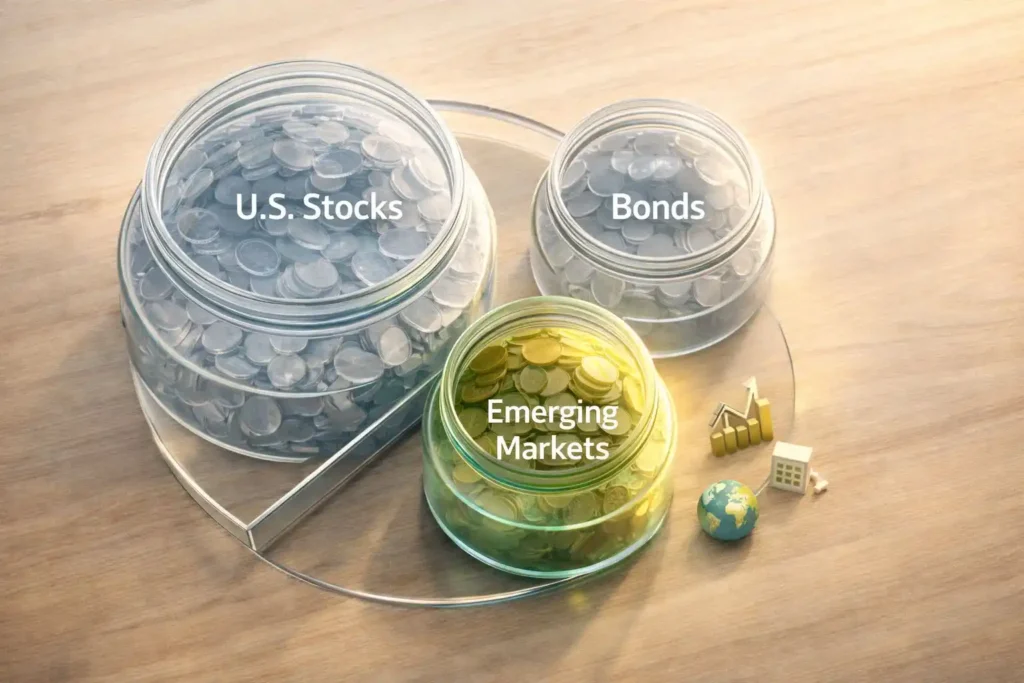
Many financial advisors suggest allocating somewhere around 5% to 15% of your stock portfolio to emerging markets. Why that range? It’s big enough to boost growth and diversification, but not so large that a meltdown in one country will sink your whole ship.
Consider these factors to personalize your allocation:
• Your Risk Tolerance: Are you okay with seeing your investments swing up and down a lot?
• Your Time Horizon: Generally, the longer you plan to invest, the more you can afford to allocate to emerging markets.
• Your Overall Portfolio & Goals: If international diversification is a key goal, you might aim closer to global market weight (~10%). If growth is your focus and you believe strongly in emerging economies, you might intentionally overweight (maybe ~20% of equities).
The bottom line: There’s no magic number that works for everyone. It could be 0%, it could be 20%. But for most investors, having some emerging market exposure (like 5-10% of your stock portfolio) is a reasonable starting point.
Common Mistakes to Avoid with Emerging Markets
Even seasoned investors slip up with emerging markets. Steer clear of these pitfalls:
• Going All-In (or All-Out): Don’t put an extreme portion of your money into emerging markets just because they’re “hot.” Conversely, don’t avoid them entirely out of fear. Balance is key – it’s about diversification, not betting the farm on one idea.
• Chasing Past Performance: Emerging markets had a great year? Nice – but that doesn’t guarantee next year will be the same.
• Picking Single Countries or Stocks First: Beginners should start with broad EM funds or ETFs, not by betting on, say, just Brazil’s market or a trendy company in India.
• Ignoring Volatility: Remember that your U.S. dollars will be invested in foreign currencies. If those currencies drop relative to the dollar, it can hurt your returns. Likewise, political events (elections, policy changes) can have outsized effects.
FAQs: Investing in Emerging Markets
Q: Are emerging markets too risky for a beginner investor?
A: Not necessarily. It’s true that emerging markets are volatile and can be risky in the short term, but in a small proportion of a diversified portfolio, they’re manageable. The key is to not overdo it – start with a modest allocation (like 5-10% of your stocks) and ensure you’ve got your basics (emergency fund, etc.) covered first. Over the long term, that small exposure could boost your returns, and you’ll learn to weather ups and downs. If the volatility of emerging markets makes you very uneasy, it’s okay to hold off until you build more confidence as an investor.
Q: What’s the easiest way to invest in emerging markets?
A: The simplest way is through a broad emerging markets mutual fund or ETF. These funds bundle dozens (even hundreds) of stocks from various emerging countries, giving you instant diversification. Examples include ticker symbols like VWO (Vanguard FTSE Emerging Markets ETF) or EEM (iShares MSCI Emerging Markets ETF). By buying one fund, you’re effectively investing in a whole basket of emerging market companies. This is far easier (and safer) than trying to pick individual foreign stocks. Just choose a fund with low fees that tracks a well-known index, and you’re off to the races.
Q: What’s the difference between emerging markets and frontier markets?
A: Frontier markets are a step below emerging markets – think of them as the “pre-emerging” countries. They are smaller, less developed economies with nascent stock markets. (For example, Bangladesh, Kenya, or Vietnam are often categorized as frontier.) Frontier markets can have explosive growth but also even higher risks (illiquid markets, more political instability). In practice, most investors stick with broad emerging market funds (which focus on the larger emerging economies). Frontier markets, if you invest in them at all, should be only with money you can afford to take big risks with, usually via specialized funds.

Conclusion: Build on a Strong Foundation
Fixing your finances is a bit like getting in shape – it starts with the basics. In this guide, we began by breaking bad spending habits and plugging those financial leaks. By doing that “spending detox,” you are essentially laying a strong foundation (or, mixing metaphors, patching the holes in your boat). Only then did we move on to investing – understanding how to allocate money smartly and even venturing into emerging markets to supercharge your portfolio’s growth.
The key takeaway? Financial fitness is a continuous practice, not a one-time fix. Just as you build muscle by consistently working out, you build wealth by consistently making good money choices – spending consciously, saving diligently, and investing wisely.
Remember, mastering your spending is just the first rep in your financial workout. Ready for the next set? Learn how to build your Emergency Fund Armor so that no surprise expense can knock you off track. Keep flexing those money muscles – you have got this!
(Comment – Share – Subscribe)
References:
Business Insider – Latest News in Tech, Markets, Economy & Innovation
NerdWallet: Finance smarter
When banks compete, you win.