
Signing a loan without an exit strategy is like jumping out of a plane and then checking for a parachute. You enjoy the thrill of the purchase, but the panic sets in when that first statement arrives. Every month it’s the same treadmill – another payment, another round of “how are we going to pay this off?” The anxiety is real: rising balances, endless years left, and no clear end in sight.
A Bank Loan Exit Strategy is your freedom blueprint, not just financial jargon. It’s a proactive plan to eliminate debt ahead of schedule – not passively trudging through the loan term. Ask yourself: What is the loan exit strategy for you? Is it just accepting the contract’s timeline, or do you have an active game plan?
This guide delivers the calculations, contract loopholes, government program truths, and a step-by-step action plan to break out of debt prison. We’ll build your personal escape route, from a proven payoff formula to hidden contingencies. Let’s pull the ripcord and start your prison break.
What is a Bank Loan Exit Strategy? (And Why Yours is Probably Broken)
A Bank Loan Exit Strategy is simply your plan to pay off a loan before its official term ends. In plain terms, it’s how you escape the debt instead of just living with it. Most people take loans like road trips without maps – they know where they started and will eventually arrive at payday, but have no idea of shortcuts or detours.
Imagine driving cross-country (your debt) without GPS or roadside help (your exit plan). Now picture instead a map with pit stops and emergency exits. The exit strategy is like those emergency stops: a proactive roadmap, not just a passive ticket. Borrowing usually feels like: “I’ll just pay the minimum each month and that’ll be fine.” That approach is broken by design – it ignores interest savings, life changes, and sneaky penalties.

Actionable self-audit: Do you know your loan’s exact principal, interest rate, or any prepayment penalties? Do you have a deadline (wedding, college, retirement) that you want debt-free by? If you are fuzzy on these, your strategy is incomplete. Reflect on these quick questions:
• How much do I still owe and what is the interest portion each month?
• Does the contract penalize me for paying off early?
• What’s my next big financial goal (buying a home, starting a business, retirement)?
If the answers are not clear, your exit strategy is probably broken. Time for a reboot.
The Golden Rule: Choosing a Loan Based on Exit Strategy
Most borrowers pick loans by monthly payment or interest rate. We flip the script: choose loans by how easy they let you escape. A great loan isn’t just cheap – it is flexible. Before signing any loan, ask: What is my Plan B?
Questions to ask before signing:
• Prepayment penalties? Always check if paying extra or finishing early triggers fees. If so, how much?
• Recast option? Can you make a lump-sum payment and have the balance re-amortized (recast), reducing future payments? If yes, this lender is exit-friendly.
• Servicer’s rules: Some servicers automatically apply extra money to future payments, not principal. Ask if you can specify “principal-only” payments so you instantly cut debt. (Many people don’t realize they must instruct this each time.)
• Application of windfalls: Does the lender accept occasional large payments (bonuses, tax refunds) without hassle?
• Loan assumption: Can someone else assume (take over) this loan if you sell the asset? Some mortgages and auto loans are assumable, letting a buyer relieve you of debt (with lender’s approval).
The “Flexibility Scorecard”
Not all debt is equal. Here’s a rough exit-friendliness ranking for common loans:
- Credit Cards: Score: Medium. No set term means no “end date,” but no prepayment penalties. You can pay off any amount anytime. However, rates are high, so the interest cost is steep. Use cards only if you’ll pay them off quickly.
- Auto Loans: Score: Medium-High. Typically fixed-rate 3–7 year term, often no penalty for extra payments. Many allow full payoff anytime without fees. A few even let you transfer (assume) the loan to a private buyer. Interest is moderate. Check if your loan has an assumption clause or balloon payment at the end.
- Personal Loans (Unsecured): Score: Medium. Fixed term, moderate interest. Some have a small prepayment fee (like 2-3 months interest). Others have none. Usually you can pay down principal early – just confirm the rule and say “principal-only” with each extra payment.
- Mortgages: Score: Low-High (varies). If it is an open mortgage (rare in the U.S.), you repay anytime with no penalty. Most mortgages are closed-term: cheap rates but steep exit penalties. Breaking a closed fixed-rate loan usually costs the remaining interest (the interest rate differential), and breaking a variable loan often costs three months’ interest. However, mortgages do allow huge extra principal payments (with paperwork) and sometimes recasting.
Key takeaway: Don’t just pick the lowest rate – pick the one that gives you wiggle room. A slightly higher rate open loan could be much cheaper in the long run if you escape early, compared to a closed low-rate loan that traps you with penalties.
Your Bank Credit Exit Strategy Calculation: The Math of Freedom
Time for numbers. You need a simple formula to turn extra payments into months shaved off:
Freedom Equation: Remaining Principal ÷ Extra Monthly Payment = Months Cut Off Your Loan.
That’s it. For example, if you owe $10,000 and you find an extra $100 each month, you’ll cut _100 months worth of principal, which you then multiply by the monthly rate schedule to see how many actual months you save.
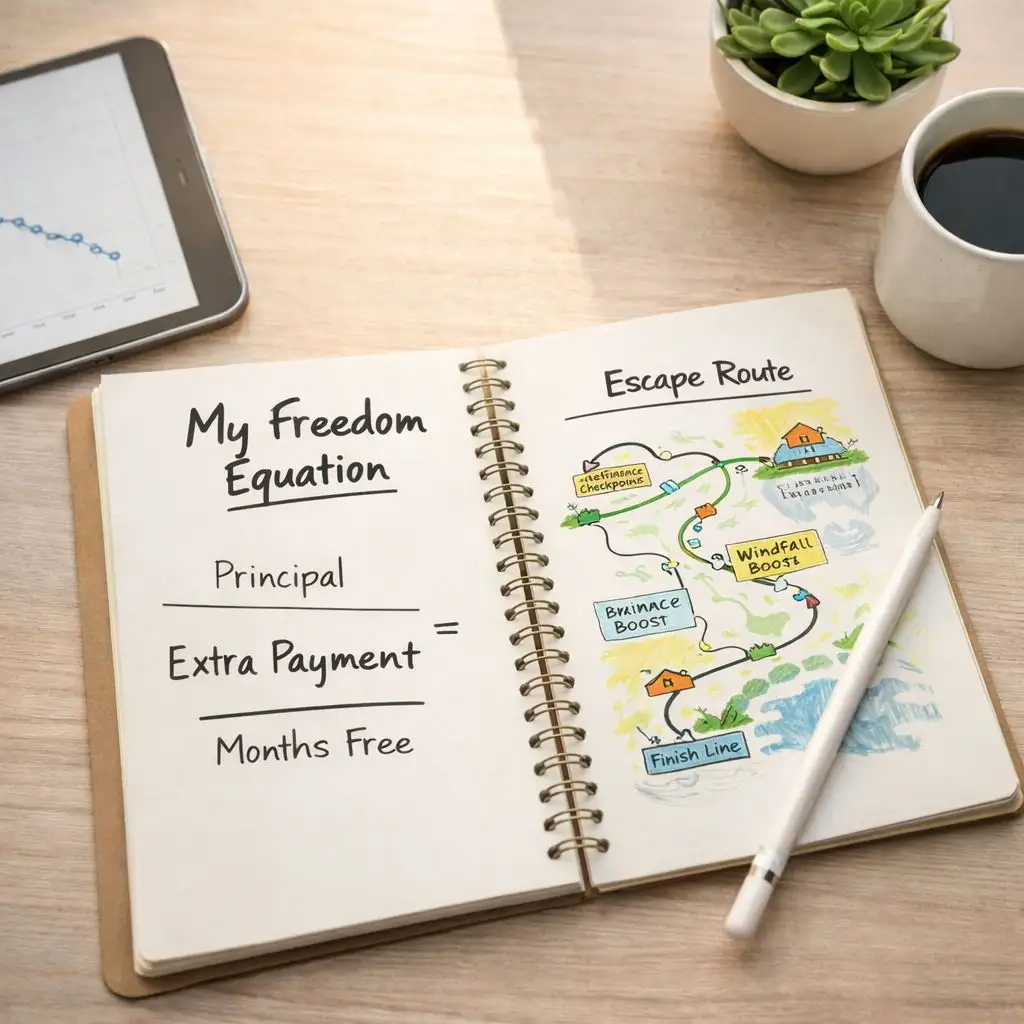
DIY Calculation Corner: Plug in your own numbers! Let’s see real examples:
• Credit Card example: Suppose a $10,000 balance at 18% APR. Minimum payments might be around $250, taking years to clear. If you commit an extra $150/month on top of your minimum, the Freedom Equation suggests you are effectively paying $150 extra toward principal. Rough math: $10,000 ÷ $150 = 67 months shaved. In practice, adding just $100 more monthly can cut years off (and save hundreds in interest). In one example, paying an extra $100 on a five-year $10,000 loan cut almost 2 years from the term and saved about $660 in interest. At 18% interest, a credit card would save even more interest by doing the same.
• Auto Loan example: A $25,000 auto loan at 5% for 60 months has a payment _ $471. If you bump it to $571 (an extra $100), you’d finish in about 48 months – shaving nearly a year. Interest saved is roughly $650. (See how monthly overpayment accelerates payoff.)
• Mortgage example: Take a $200,000 mortgage at 4% for 30 years (360 months), payment _$955. If you pay $1,255 instead ($300 extra), the new term is only _228 months (_19 years). You just cut your payoff by 75 months (over 6 years) and save on the order of _$58,000 in interest. Big bumps to principal = huge savings.
These scenarios show how powerful it is to treat that extra money as an investment in your freedom, not a side note. For guidance: Tracking a “savings waterfall” is wise – direct every spare dollar first to the highest-interest debt, then next, and so on (avalanche method), to maximize savings and speed.
The Great Escape: Tactics to Get Out of a Loan Without Charges
How can you actually bail out without a fee? Here are the smartest tactics:
- The Refinance Shuffle: If interest rates drop or your credit improves, refinancing can slash payments and term. Refinancing replaces your loan with a new one. Although closing costs exist, a lower rate/shorter term means you pay far less interest overall. As NerdWallet notes, securing a lower mortgage rate and refinancing “could help you shift more of your monthly payment towards the principal balance”. Example: refinancing a 30-year mortgage to a 15-year at a slightly lower rate might raise your payment a bit but cut decades of interest. Always calculate breakeven on fees vs interest saved.
- The Silent Weapon: Loan Recasting (Re-amortization): This is like a mini-refinance without full paperwork. You make a lump-sum payment on principal (say from savings or a bonus). The lender then “re-amortizes” your loan: your interest rate stays the same, the loan term stays the same, but your monthly payment drops. You don’t get the years back (still same term), but your payments get smaller. Recasting usually costs a modest fee (_$150–$300) – far cheaper than refinancing. According to Bankrate, recasting “reduces your mortgage payments and total interest paid” by applying a lump-sum to principal. Ask your lender if recasting is allowed on your loan (it works for many conventional mortgages, but not FHA/VA loans).
- The Power of “Principal-Only” Payments: Every dollar you send beyond your contract payment should smash principal. But you have to make it official. The CFPB advises borrowers to instruct their servicer in writing to apply extra payments to principal or highest-interest balance. Why? Some servicers automatically apply extra funds to future scheduled payments (helping only you to think you paid down your debt). Don’t let that happen. When you send extra, label it “principal payment” or call the servicer each time to set this up (many now let you set a standing instruction). This technique directly attacks the loan’s core balance. As one credit union guide shows, even a modest $100 extra per month on a $10,000 loan at 5% shaved about 2 years off the term and saved _$660 in interest.
- Windfall Strategy (Bonuses & Tax Refunds): Got a bonus, inheritance, tax refund, or big gift? Instead of splurging, throw it at your debt. NerdWallet specifically recommends dedicating overtime pay, bonuses or any “dribbling” cash to building equity (principal). You can even use unexpected inheritance funds to wipe out principal. Important tip: have the money applied to principal. Call your servicer to instruct that any lump-sum or periodic extra goes straight to the loan balance, not sitting in escrow or offsetting future payments. A one-time windfall can knock off months or years of payments.
These are the tactics you control. They often cost nothing extra (or a small fee) and avoid penalties. Together, they form your toolkit to exit debt without waiting for the natural term to end.
Emergency Exits: Last-Resort Tactics and Legal Loopholes
Sometimes you need an immediate out. Here are the rare but real escape hatches:

Getting Out of a Mortgage Before Closing: If you’ve already signed a purchase agreement but haven’t closed, certain contingencies let you cancel without penalty. The common ones are financing, appraisal, and inspection contingencies. For example, a mortgage contingency (also called “subject to financing”) allows you to back out if your loan falls through. In plain language, the contract might say you have X days to secure a loan; if you can’t, you cancel and get your earnest money back. An appraisal contingency means if the home appraises below the purchase price, you can renegotiate or exit. An inspection contingency means egregious issues (like a failing foundation) let you void the deal. The exact wording is crucial – typical phrases are “This agreement is contingent upon Buyer obtaining financing…” or “contingent upon satisfactory inspection/appraisal.” If a contingency isn’t met, the contract usually unwinds and your deposit returns. Warning: once these contingency periods expire, canceling often means forfeiting your earnest money. Always act within the agreed deadlines.
Free Government Debt Relief Programs: No program magically erases personal debt, but federal aid can help certain debts:
- Income-Driven Repayment (IDR) Plans – For student loans. These cap federal loan payments at a percentage of discretionary income and can stretch the term to 20–25 years. Pro: Lowers your monthly payment, keeping you afloat. (Payments count toward eventual forgiveness or PSLF.) Con: A much longer term means you pay a lot more interest over time. After the final forgiveness, the remaining balance becomes taxable (federal rules now phase out through 2025, but state taxes may apply). In short, IDR is a 50-year loan shuffle: very low monthly pain in exchange for paying far more interest later. Only federal loans (not private) qualify, and paperwork is annual. This is a bridge, not a quick escape.
- Public Service Loan Forgiveness (PSLF) – Also student loans. Work 10 years (120 payments) full-time in qualifying public service or non-profit, and the rest of your Direct Loan debt is forgiven (tax-free). Pro: Can wipe out large debts tax-free. Con: The rules are very strict: only Direct Loans count; you must be on the right repayment plan (usually an IDR plan); you must certify your employer each year; and any payment in forbearance or with the wrong servicer may not count. Historically only a tiny fraction of applicants succeed. (Recent policy reviews have added uncertainty.) In short, PSLF is a possible escape but a tough mountain to climb. If you attempt it, follow official guidance to the letter.
- Homeowner Assistance Fund (HAF) – For mortgages and housing costs. Established after COVID-19, it provided about $10 billion in grants to states to help homeowners behind on mortgages, insurance, or utilities due to pandemic hardship. Pro: If you qualify, HAF can cover missed mortgage or insurance payments, often as a grant you don’t repay. Con: Strict eligibility – you must demonstrate COVID-related hardship (like job loss or medical bills) and meet income limits. The money is finite and goes through state programs, so availability and rules vary. It doesn’t erase the mortgage; it helps you catch up. Note: using HAF funds won’t ruin your credit (it actually stops foreclosure), but it requires paperwork to prove hardship.
Each program has a purpose but also strings attached. Think of these not as quick fixes, but as last-resort bridges if your debt is truly unmanageable. They are not substitutes for your own strategy, but tools in the toolkit.
Building Your Personalized Exit Plan: A 5-Step Blueprint
Turn theory into action. Here’s a bulletproof plan to follow:
1. The Tally – Know Your Debts. List every loan (credit cards, auto, mortgage, student, personal). Record the balance, interest rate, minimum payment, and any special terms (prepayment penalty, next reset date). Seeing the big picture is half the battle.
2. The Target – Pick a Payoff Method. Decide your killer strategy: Avalanche (highest interest first) or Snowball (smallest balance first). Both work if you stick with them. Psychology matters: avalanche saves money on interest, snowball gives quick wins. Choose what keeps you motivated and focus like a laser on that debt.
3. The Treasure – Free Up Extra Cash. Audit your budget: where can you trim spending? Bundle insurance, downsize a subscription, cook more at home. Even small cuts (coffee, streaming services) add up over months. Direct that “found money” to debt. Also earmark irregular income: tax refunds, bonuses, gift checks – as debt payments. This is your hidden treasure. (For structure, implement a “savings waterfall”: after essentials and emergency fund, dump every extra dollar into your highest-priority debt.)
4. The Talk – Coordinate with Your Servicer. Call each lender. Confirm your plan: explain you’ll be paying extra and want it applied to principal. Some loans let you do this online; others need a phone call. If applicable, ask about recasting (mortgages) or loan consolidation to a no-cost loan. Clarify when payments post. For example, paying mid-cycle on credit cards can avoid interest accrual until next statement. Make sure your “overpayment” is handled correctly.
5. The Tenacity – Track Progress & Stay Motivated. Set a payoff calendar. Mark each big reduction and celebrate it (maybe a small treat when you knock out a loan!). Use an app or spreadsheet to watch balances drop. Revisit and adjust: if income rises, up your payment automatically. Remember your why – the freedom at the end. Every month you stick to the plan, you’re one step closer to escape.
At each step, keep your budgeting for payoff razor-sharp. Even when life happens, find a way to keep paying something extra (even $20 does work over time). The discipline you build now compounds into real freedom down the road.
Common Mistakes That Can Keep You Stuck Longer
A strong bank loan exit strategy is not just about what to do. It is also about what not to do. Many borrowers stay trapped longer than necessary because they make avoidable mistakes that quietly waste money and time.
1) Paying extra without confirming where it goes
One of the biggest mistakes is assuming extra payments automatically go to principal. That is not always true. Some servicers apply extra money to future payments unless you specify otherwise.
That means your hard-earned overpayment might not accelerate your payoff the way you think it does. Always confirm that extra funds are applied to principal only.
2) Choosing the lowest monthly payment instead of the best exit strategy
A low payment can feel comforting, but comfort is not the same as strategy. A borrower who chooses a loan only because it looks affordable may end up locked into a long repayment timeline or a difficult exit.
A loan should be judged by both affordability and flexibility. That is why choosing a loan based on exit strategy matters so much.
3) Ignoring prepayment penalties and contract terms
Some borrowers focus only on the APR and ignore the fine print. That is a costly mistake. A loan with a slightly better rate may still be more expensive overall if it has rigid penalties or expensive early-exit conditions.
Always read the section on early payoff, refinancing, and servicing terms.
4) Waiting for a “perfect” income before starting
Many people delay their exit plan because they think they need a huge raise first. They do not. A strong plan starts with a small, repeatable extra payment and grows from there.
Even modest overpayments can create real acceleration.
5) Relying too heavily on relief programs
Free government debt relief programs can help, but they should not be the only strategy. If you depend entirely on forgiveness or assistance, you may end up waiting longer than necessary and paying more interest in the meantime.
Use relief options as support, not as your entire plan.
6) Not revisiting the plan after a financial change
A loan exit strategy is not a one-time decision. It should be reviewed after every raise, bonus, refinance opportunity, or major expense change. The fastest exits often come from people who keep adjusting.
FAQs: Bank Loan Exit Strategy Questions Readers Actually Ask
1) What is the loan exit strategy for you?
A loan exit strategy is the specific plan you use to get out of a debt faster, cheaper, or more safely than simply making minimum payments until the loan ends. For one person, it may mean paying extra on a credit card every month. For another, it may mean refinancing a mortgage, using a recast loan, or preparing to sell an asset that secures the debt.
The best way to define what is the loan exit strategy for you is to ask three questions:
1. Which debt costs me the most in interest?
2. Which debt creates the most monthly pressure?
3. Which debt can I realistically eliminate first without hurting my stability?
Your exit strategy is not the same as someone else’s. A borrower with a 22% APR credit card needs a very different plan than a homeowner who is considering whether to get out of a mortgage contract before closing or use an appraisal contingency. Your strategy should match your cash flow, your timeline, your risk tolerance, and your goals.
The most important mindset shift is this: a loan is not just something to survive, it is something to design an exit from.
2) How do I do a bank credit exit strategy calculation?
A bank credit exit strategy calculation is simply the math that shows how extra payments reduce your payoff timeline. The simplest version is:
Remaining balance ÷ extra monthly payment = rough months to freedom
That is not a full amortization model, but it is a powerful starting point. It helps you understand how much your overpayment changes the timeline. If you owe $12,000 and can pay $300 extra each month, your rough payoff acceleration is 40 months of extra principal contributions.
To make the calculation more useful, add three things:
• Your current balance
• Your interest rate
• Your minimum payment
Then ask: how much faster would I be debt-free if I paid $50, $100, $200, or $500 extra each month?
That is where a true financial plan begins. A credit card balance is the easiest place to see the effect because high interest makes even small extra payments meaningful. An auto loan often responds well too. A mortgage may show slower visible change month to month, but principal acceleration can still save a massive amount over the long run.
The real purpose of the calculation is not just to estimate timing. It is to help you decide where every extra dollar should go.
3) What does choosing a loan based on exit strategy actually mean?
Most people choose loans based on approval, monthly payment, or interest rate. But choosing a loan based on exit strategy means you also ask how easy it will be to leave that loan later.
That means checking for:
• Prepayment penalties
• Recast availability
• Refinancing flexibility
• Assumption options
• Servicer rules for extra payments
• Fees tied to early payoff
This matters because two loans with similar payments can behave very differently once your financial life changes. A loan that looks affordable today may become expensive if you need to leave early, sell the house, or pay it off with a windfall. On the other hand, a slightly higher-rate loan with no penalty and flexible payoff terms may be better if your goal is speed and control.
In other words, choosing a loan based on exit strategy is about buying optionality. Optionality is power.
4) Is it possible to get out of a loan without charges?
Sometimes, yes. The phrase get out of loan without charges usually refers to avoiding prepayment penalties, lender fees, or unnecessary closing costs while exiting the debt early.
The cleanest ways include:
• Paying the loan off with no prepayment penalty
• Making principal-only payments
• Refinancing into a better loan with low or no closing costs
• Using a recast loan for mortgages, if allowed
• Taking advantage of a grace period or fee waiver when the lender offers one
• Negotiating with the servicer before falling behind
The key is to know the exact wording in your loan contract before you act. Some borrowers think they can save money by paying off a loan early, only to discover they triggered a fee or applied payments incorrectly. The goal is not merely to pay faster. The goal is to pay smarter.
Also, if you have credit card debt, some balance transfer offers can function like a temporary escape route. But those only work if you understand the transfer fee, the promotional window, and the post-promotional APR.
5) What is the best way to get out of mortgage contract before closing?
The phrase get out of mortgage contract before closing usually applies to a home purchase, not the mortgage itself. This is where contingencies matter.
The most common legal exit points before closing are:
• Financing contingency
• Appraisal contingency
• Inspection contingency
• Title contingency
• Insurance contingency
• Sale-of-home contingency
If the contract is written properly and the deadline has not passed, these can give you a legitimate exit route. The best-known example is financing: if you cannot secure the loan under the agreed terms, you may be able to cancel the contract and recover earnest money.
The important detail is timing. Contingencies are not forever. They are built-in escape hatches with expiration dates. If you ignore the date, the protection may disappear.
This is why readers need to understand that one of the smartest forms of a bank loan exit strategy begins before the debt is even signed. A strong buyer protects the exit before they need it.
6) Are free government debt relief programs really free?
This is one of the most important questions in the entire article. The answer is: sometimes, but never costless in every sense.
Free government debt relief programs can include options like income-driven repayment, Public Service Loan Forgiveness, or housing assistance programs. These are not scams. They are real programs. But “free” does not always mean easy, fast, or emotionally simple.
The real trade-offs are often:
• Longer repayment timelines
• More interest paid over time
• Strict eligibility requirements
• Annual paperwork
• Employment restrictions
• Possible tax consequences in some cases
• Credit profile effects depending on the program and how it is used
For student loan borrowers, income-driven repayment can lower the monthly burden, but it may increase total interest paid. PSLF can be powerful for eligible public service workers, but it requires discipline and documentation. Housing-related relief may help in hardship situations, but the assistance usually has rules tied to income, occupancy, and hardship status.
The honest truth is that government debt relief is best viewed as a support system, not a shortcut. It can be a meaningful part of a broader debt freedom plan, especially if your income is unstable or your debt load is temporarily overwhelming.
7) Should I use an early payoff calculator or just follow my budget?
Use both. A budget tells you what you can afford. An early payoff calculator tells you what that extra payment actually does.
The calculator helps you see the emotional payoff of discipline. When a borrower sees that an extra $100 per month can shave years off a loan, the budget suddenly becomes more motivating. The math creates momentum.
The ideal approach is to build a savings waterfall:
• Protect essential living expenses
• Maintain a small emergency reserve
• Direct extra money to the debt with the best payoff value
• Recalculate after each milestone
That way, your budget becomes action, and your action becomes progress.
Conclusion
A Bank Loan Exit Strategy turns debt from a life sentence into a defined tour of duty. It gives you control: the debt’s size doesn’t matter as much as the clarity of your plan. By choosing loans for flexibility, doing the math, and using every tool (extra payments, recasting, windfalls, even government help), you transform an endless slog into a finite mission.
Remember: the power is in your plan. Your future loans should have their own escape routes built in, making you the warden with the key – not a prisoner of interest.
So do not wait for New Year’s. Open a new tab, pull up your loan statements, and complete Step 1: The Tally. Outline your debts right now. Your future self will soon celebrate “Freedom Day.”
Call to Action:
• Stuck on a tricky clause or strategy? Share your challenge in the comments below – our community is here to problem-solve together.
• Found this guide helpful? Pay it forward by sharing it with a friend who needs out of the debt forest.
• For more no-BS strategies to hack your financial life, subscribe to TheFitFinance newsletter for weekly tips you can actually use.
Your debt exit is waiting for you, Now understand Exploding Credit Card Debt Crisis in America: Causes, Consequences, and Solutions