
Sarah’s Secret Weapon;
Sarah clicked on a five-minute explainer and left more confused than when she began. The comments were a mix of jargon, memes, and heated fights — and she was too embarrassed to ask what “seed phrase” actually meant. That nervousness is exactly why a cryptocurrency forum for beginners can change everything.
Imagine a moderated corner of the internet where questions get answered without the side-eye, where experienced members drop short, tested explanations and moderators remove FUD and scammers. This guide is written as if that forum is your patient teacher: we’ll answer core questions, teach you how the tech actually works with fresh analogies, and give actionable steps to stay safe. Follow the checklist and the roadmap inside; by the time you finish, you will know what to ask in a forum, how to judge answers, and how to take the next small, low-risk steps in crypto.

Why Your First Step Should Be Finding a cryptocurrency forum for beginners
Think of learning crypto like joining a new sport. You could watch highlight reels forever, but you will absorb the rules — and avoid early mistakes — far faster if you join a team with a coach.
Three signs of a high-quality beginner forum:
• Respectful moderation — moderators who remove scams and personal attacks.
• A dedicated “noob” or newbie section — where basic questions are encouraged and tagged.
• Structured resources — pinned guides, glossary, and “best-of” archived threads.
Actionable steps (quick):
1. Bookmark three candidate forums (one global, one regional, one niche).
2. Read the forum rules and the pinned threads first.
3. Lurk for 48 hours: observe tone, response time, and whether moderators engage.
Key takeaway: A forum speeds learning by turning strangers into a curated feedback loop — you save time and avoid avoidable errors.
Crypto Decoded: Answering Your Top Forum Questions
(This whole section reads like the FAQs pinned at the top of a friendly community.)
What is Cryptocurrency?
Cryptocurrency is digital money secured by cryptography that records ownership and transfers across decentralized networks. It exists as code and transactions are verified by distributed participants instead of a central bank. People use it for payments, digital ownership, programmable contracts, and speculative investment.

Cryptocurrency Core Concept: It is About Verification, Not Magic
At its heart, cryptocurrency solves one problem: how to agree on who owns what without trusting a single middleman. Instead of a bank keeping a private file, a distributed community tracks ownership and verifies transfers. The aim is not to create “mystery money,” it is to create a shared, auditable system of proof.
Simple analogy: think of all transactions as edits to a community-led Google Doc where hundreds of people can verify each change. Every approved edit is permanent and timestamped — and you only trust edits that multiple trusted editors confirm.
How Does Cryptocurrency Actually Work? — A Mailroom Analogy
Imagine a futuristic mailroom for digital packages:
• Sender puts a package in a transparent dropbox and writes a secure address on it (public key).
• Private key is the only key that can authoritatively say, “Yes — I sent this.”
• Couriers (network nodes) pick up the dropbox entries, check paperwork, and collectively stamp a ledger page.
• Once a large group signs off, that page is filed and cannot be removed.
Why this matters: public keys are like visible mailbox labels, private keys are like the physical key to open mail — losing the private key is like losing the only copy of that key forever.
Forum tip: Ask members to show you visual step-by-step examples (screenshots of a mock transaction) before you try one.
What is Mining? — The Competitive Bookkeeping Race
Mining is how some networks decide which new page gets added to the community-led document. Imagine a race where many volunteers try to solve a tricky puzzle; the first to finish gets to lock the next page, file it, and earn a reward.
• Purpose: secure the network and confirm transactions.
• Mechanic: competition + computational work (Proof of Work) or other consensus methods like Proof of Stake.
• Analogy: miners are competitive bookkeepers racing to solve a math riddle — the winner files the entry and collects the tip.
Forum insight: you will see threads where veterans explain mining in layman’s terms — read those before you try to mine or buy mining gear.
The Crypto Family Tree: Major Types of Cryptocurrencies
• Bitcoin — Store of Value: simple design, limited supply. Think of it as digital gold.
• Ethereum — Programmable Platform: supports apps, contracts, and tokens; more flexible than Bitcoin.
• Stablecoins — Digital Dollar Equivalents: tied to fiat value; useful for trading and avoiding volatility.
• Utility Tokens & Platform Coins: give access to services or features on a platform.
• Memecoins & Community Tokens: social-driven tokens; high risk, sometimes high reward.
Forum practice: whenever a new token appears, search forum threads for explainers, tokenomics, and team transparency. Look for independent audits and red-flag lists.
Read here in detail> Top Cryptocurrency Investments This Year (That Actually Make Sense) ~ Here is Why Smart Money is All in – The Fit Finance
The Good, The Bad & The Ugly: Weighing Crypto Honestly
Cryptocurrency has bright advantages and real drawbacks. A balanced forum will discuss both without hype.
Advantages of Cryptocurrency: Beyond “Getting Rich”
• Financial self-custody: control assets yourself without reliance on a bank.
• Global access: move value across borders with fewer intermediaries.
• Programmable money: smart contracts automate agreements.
• Inflation hedge argument: some cryptocurrencies have fixed supplies.
Forum value: beginner communities often have separate threads comparing crypto features to traditional banking — use those for context, not gospel.
Disadvantages & Risks Veterans Always Warn About
• High volatility: dramatic price swings can occur within hours.
• Irreversibility: mistaken transactions are rarely reversible.
• Scams & rug pulls: new tokens and projects often hide malicious intent.
• Complexity: user error (losing a private key) leads to permanent loss.
Important forum mantra: “Don’t keep your crypto on exchanges.” You’ll see this repeated because exchanges can be hacked, freeze withdrawals, or be subject to legal action. A responsible beginner forum will have pinned instructions on how to withdraw to personal wallets safely.
Your Crypto Toolkit: Wallets, Safety, and Staying Updated
Cryptocurrency Assets and Wallets: Your Digital Safe
• Hot wallets: connected to the internet (phone apps, browser extensions). Convenient but more exposed.
• Cold wallets: offline storage (hardware devices, paper backups). Best for long-term holdings.
• Custodial wallets: you trust a third-party service (like an exchange) to hold keys.
Practical quick list:
• Use a hardware wallet for significant holdings.
• Use hot wallets for small, everyday moves.
• Keep seed phrases offline and in two secure locations.
Bold takeaway: if you own crypto, learn basic wallet mechanics first.
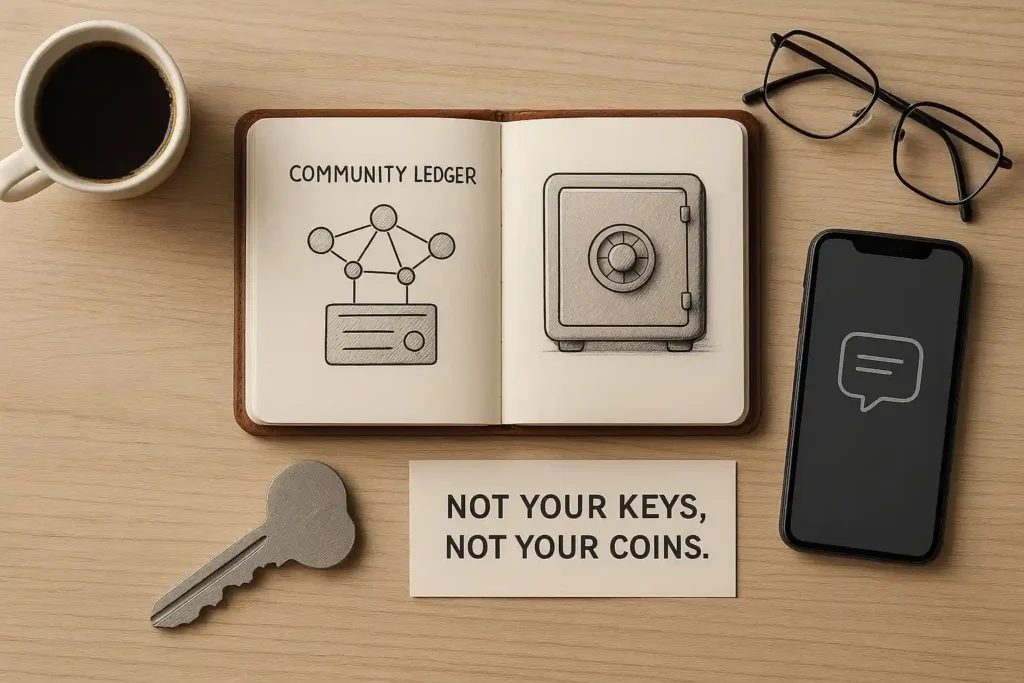
Why “Not Your Keys, Not Your Coins” is Gospel
Think of an exchange like a bank vault that issues paper IOUs. If the vault closes, your IOU may become worthless. Owning the private key means you actually hold the asset, not the IOU. The bank vs. safety-deposit-box analogy fits here: trusting exchanges is like trusting a room full of deposit slips — convenient, but risky.
Forum assignment: find the pinned “how to move funds off exchanges” thread and follow its step-by-step test with a tiny amount first.
Once you understand wallets, private keys, and self-custody—topics regularly discussed in any cryptocurrency forum for beginners—the next smart step is thinking long-term. That includes preparing your crypto for future threats like quantum computing, which we explain in our detailed guide on quantum-proofing your crypto.
Can Crypto Really Protect You From Inflation?
Short answer: It can, sometimes — but not reliably for short-term holders.
• Bitcoin’s fixed supply is designed to resist inflation in theory.
• Reality check: market prices react to speculation, macro events, and liquidity, so volatility can erase gains quickly.
Research steps inside a forum:
1. Search long-term historical charts and read community analysis.
2. Compare Bitcoin’s performance against local inflation in multiple threads.
3. Look for cross-referenced academic research or reputable analyst threads pinned by moderators.
A Good Read
Staying in the Loop: Navigating Cryptocurrency News & Discussion
Why forums beat social media for beginners:
• Moderated discussions reduce spam and one-line pump messages.
• Community archives hold long-form explainers you can re-read.
• Members often summarize complex news in simple threads.
How to filter signal from noise:
• Prefer posts that show sources (links to whitepapers, audit reports).
• Beware of hot takes with zero evidence.
• Check whether a consensus forms over time — single-person posts often mislead.
Forum habit checklist:
• Read the daily news roundup thread instead of random tweets.
• Bookmark a handful of trusted members whose post history is high-quality.
• Use the forum’s search tool — search exact token names and “audit” or “scam” tags.
Find Your Perfect Beginner Forum — cryptocurrency forum for beginners Checklist (Interactive)
Below is a practical checklist you can copy, paste, or print. Use it when vetting forums.
Forum Vetting Checklist
• ☐ Dedicated newbie/noob section with pinned guides
• ☐ Clear code of conduct and active moderation
• ☐ Recent activity: at least 10 posts/day in core sections
• ☐ Pinned “how to start” tutorial with screenshots
• ☐ Searchable archives and “best-of” threads
• ☐ Reputation system (karma, badges, or verified experts)
• ☐ Scam-watch/blacklist pinned thread or wiki page
• ☐ Active threads about wallet safety and withdrawal guides
• ☐ Friendly tone (no dogpiling on newbies)
• ☐ Local or regional subforum option (for country-specific rules)
How to use the checklist (3 steps):
1. Pick three candidate forums and apply the checklist.
2. Score them (1 point per checkbox) and pick the top-scoring one.
3. Introduce yourself in the newbie thread with a short question.
Bonus: Copy this checklist into your notes app so you can use it while browsing.
Practical Forum Etiquette & How to Ask Questions (Short Guide)
Do:
• Read pinned threads before posting.
• Use clear titles: “Beginner: How to move BTC from Coinbase to Ledger Nano?”
• Share what you’ve already tried and include screenshots (never your private keys).
Don’t:
• Post private keys, seed phrases, or personal data.
• Ask for investment advice phrased as “Will X go to $10k?” (too speculative).
• Respond to moderator actions with hostility — ask politely for clarification.
Example good post (template):
Title: Beginner — Moving ETH from Exchange to MetaMask (step check)
Body: I have 0.02 ETH. I want to test moving funds from Coinbase to MetaMask. I’ve opened MetaMask, created an account, and copied my public address. Before I send, can someone confirm these steps are safe? Screenshot attached (address only). Thanks!
Safety Deep Dive — Avoiding Scams, Phishing & Rug Pulls
Common scam patterns:
• Impersonation: fraudsters copy famous users’ names with small differences.
• Phishing: fake websites that mimic wallet or exchange login pages.
• Pump-and-dump: coordinated hype to inflate a token price before selling.
Checklist to stay safe:
• Verify links from forum posts — hover to check domains.
• Use bookmark links for exchanges and official projects.
• Never share seed phrases; the only time a legitimate moderator or support asks for them is never.
If you suspect a scam:
1. Stop interacting with the account.
2. Report the thread and user to moderators.
3. Share a clear, factual post with evidence so others are warned.
Forum culture note: responsible beginner forums have pinned “how to report scams” instructions and a rapid response team. Use them.
Moving Beyond Basics: Practical First Steps (A Mini Action Plan)
Week 1 — Explore & Learn
• Join a vetted beginner forum and read pinned threads.
• Lurk and upvote useful posts.
• Ask 1–2 simple questions.
Week 2 — Wallet Basics
• Install a reputable hot wallet and create a small test transfer.
• Learn seed phrase backup procedure; practice with a mock seed.
Week 3 — Safety Practice
• Set up a hardware wallet if you plan to hold meaningful value.
• Move a small amount from an exchange; confirm you can receive and send.
Week 4 — Small Trade + Reflection
• Try a small trade for learning, not profit — $10–$50.
• Post your experience in the forum’s learning thread and ask feedback.
Bold action reminder: never move large sums until you’ve done small practice runs and gained confidence.
Advanced Forum Uses: Research, Due Diligence & Project Vetting
Once comfortable, use forums for deeper research:
• Tokenomics threads: look for detailed breakdowns of supply, distribution, and vesting.
• Audit & code review summaries: read community-generated summaries of audits.
• Team transparency checks: search for the founders’ public profiles and previous projects.
• On-chain analysis: some forum members post easy-to-follow on-chain metrics (e.g., active addresses, whale movements).
Two cautionary tips:
1. A single positive post doesn’t equal legitimacy — look for multiple independent confirmations.
2. Don’t confuse technical complexity with quality — sometimes simple and transparent projects are the safest.

FAQs (Frequently Asked Questions):
Cryptocurrency Forum for Beginners
1) What is the best way for a complete beginner to start learning crypto?
The safest starting point is education, not buying. A cryptocurrency forum for beginners works well because it lets you learn in small steps, ask basic questions, and see how real people explain concepts in plain language. Start with the terms, then wallets, then security, and only after that move to small test transactions. This reduces confusion and lowers the chance of costly mistakes.
2) Why is a cryptocurrency forum for beginners better than random YouTube videos or social media posts?
Because a good forum gives you structure, context, and moderation. Social media often rewards excitement, not accuracy. A cryptocurrency forum for beginners usually has pinned guides, repeated questions, and replies from people who have already seen the same beginner mistakes many times. That means you can learn the basics without getting lost in hype, fear, or exaggerated profit claims.
3) What should I look for in a good beginner crypto forum?
Look for three things: respectful moderation, a beginner-friendly section, and educational threads that are archived and easy to search. The best cryptocurrency forum for beginners should feel calm, not chaotic. If a forum is full of scams, spam, or people shaming simple questions, it is not helping you learn. A strong forum makes confusion smaller, not louder.
4) What is the most important thing to understand before buying any cryptocurrency?
Understand custody and keys first. In crypto, ownership is not just about buying a coin; it is about controlling access. That is why people in a cryptocurrency forum for beginners keep repeating “not your keys, not your coins.” If you do not understand wallets, private keys, and seed phrases, you are not ready to store meaningful funds safely. Learn protection before profit.
5) What is the difference between a wallet and an exchange?
An exchange is a platform where you buy, sell, or trade crypto. A wallet is where you store and control it. Many beginners confuse the two. In a cryptocurrency forum for beginners, this is one of the first lessons because it matters a lot. If your crypto stays on an exchange, the platform controls the keys. If it is in your wallet, you control access.
6) Is crypto really decentralized, and why does that matter?
Decentralization means no single company or bank fully controls the network. Instead, many independent participants help verify activity. This matters because it reduces dependence on one authority and makes the system harder to censor or shut down. A good cryptocurrency forum for beginners explains decentralization in simple terms: not as a buzzword, but as the reason crypto works differently from normal online payment systems.
7) How do I avoid scams as a beginner?
Never share your seed phrase, private key, or recovery phrase with anyone. Ignore “guaranteed profit” promises, fake support messages, and urgent links sent by strangers. A solid cryptocurrency forum for beginners will have scam alerts and warnings about phishing. Before clicking anything, verify the website manually. Before sending money, test with a tiny amount. Slow is safer than sorry.
8) Should I keep my crypto on an exchange for convenience?
Only temporarily, and only if you understand the risk. Exchanges are convenient for buying and selling, but they are not the safest long-term storage option. That is why any honest cryptocurrency forum for beginners will warn you not to leave large amounts on exchanges. For learning, keep a small amount online if needed. For holding, learn cold storage and self-custody.
9) Can cryptocurrency protect me from inflation?
Sometimes it is discussed that way, especially with assets that have limited supply. But crypto is not a guaranteed inflation shield. Prices can rise sharply, fall sharply, or stay flat for long periods. A thoughtful cryptocurrency forum for beginners will not oversell this idea. It should explain that inflation protection depends on the asset, the time frame, and your risk tolerance.
10) What kind of questions should I ask in a beginner crypto forum?
Ask practical questions, not speculative ones. Good questions include: “What is a seed phrase?”, “How do I move funds safely to a wallet?”, “What is the difference between hot and cold storage?”, and “How do I spot a scam?” A cryptocurrency forum for beginners is most useful when you ask clear, specific questions and explain what you already understand.
11) How do I know whether a crypto discussion is useful or just hype?
Useful discussion is specific, evidence-based, and calm. Hype is emotional, vague, and full of predictions with no explanation. In a quality cryptocurrency forum for beginners, look for members who explain the “why,” not just the “what.” The best threads show sources, examples, risks, and downside cases. If a post only says “buy now,” it is not teaching you anything.
12) What is the smartest first step after reading a beginner crypto guide?
Join one good forum, read the pinned posts, and ask one simple question. Do not rush into trading. The real power of a cryptocurrency forum for beginners is that it gives you a place to learn in public, without embarrassment, and improve through community feedback. One clear question can save you from a very expensive mistake later.
Can Cryptocurrency Protect You From Inflation? (Deeper Look)
The theory: some cryptocurrencies — especially Bitcoin — have limited supply, which theoretically offers protection against inflation caused by unlimited fiat printing.
The practical reality:
• Short-term: price volatility can lead to large paper losses.
• Long-term: historical data shows periods of both outperformance and underperformance compared to inflation metrics.
Forum research routine:
1. Ask for long-term comparison charts (BTC vs. CPI) and read multiple analyst threads.
2. Look for community consensus, not single bullish posts.
3. Factor in local currency considerations — inflation impact is regional.
Balanced takeaway: crypto can be part of an inflation mitigation strategy — but not the sole one for most beginners.
Cryptocurrency News & Discussion: How to Use Forums Effectively
Best practices for news consumption within forums:
• Prefer posts linking to primary sources (official blog, GitHub, audit reports).
• Look for threads with multiple fact-checked replies; one-person op-eds are opinions, not facts.
• Use the forum’s “news” or “analysis” tags to filter.
When a big story breaks:
1. Read the primary source (project blog or official channel).
2. Scan the forum’s pinned “megathread” for consolidated facts.
3. Wait 24 hours for confirmations before making decisions.
Why forums help: they consolidate diverse perspectives and often host AMAs (Ask Me Anything) with project teams — but treat those events skeptically and cross-check claims.
Final Checklist: Your Forum Onboarding Cheat-Sheet
• ✅ Join 1-2 forums and read the rules.
• ✅ Lurk for 48 hours and observe tone.
• ✅ Use the vetting checklist before trusting a forum.
• ✅ Practice wallet moves with small amounts first.
• ✅ Bookmark official links and avoid clicking unknown ones.
• ✅ Report scams and contribute constructive summaries when you learn something.
Beginner Crypto Glossary (Straight From a Cryptocurrency Forum for Beginners)
If you spend even one day inside a cryptocurrency forum for beginners, you’ll see these terms repeated constantly. Bookmark this list—it’s designed to help you follow discussions without feeling lost.
- Address: A public identifier used to receive cryptocurrency, similar to sharing your email so others can send you messages.
- Private Key / Seed Phrase: A secret code that gives full access to your crypto funds—never share it, even with “support.”
- Hot Wallet: An internet-connected wallet that’s convenient for daily use but requires strong security habits.
- Cold Wallet: Offline crypto storage that offers higher protection against hacks and online threats.
- Exchange: A platform where people buy and sell crypto, but one that usually controls your assets unless you withdraw them.
- Stablecoin: A cryptocurrency designed to track the value of traditional money like the U.S. dollar.
- Smart Contract: Self-executing code on a blockchain that automatically enforces agreements without middlemen.
Your Map and Your Guide
Education > Speculation. The road to understanding crypto begins with questions, not fast trades. A cryptocurrency forum for beginners becomes a living, evolving guide — your safe place to ask, test, and learn. Use the checklist, follow the short action plan, and treat each small practice move as a lesson, not a bet.
You now have the map. The forum is your guide. Your journey to understanding starts now.
Next step: Ready to move toward low-risk action? Read our post: “Low-Risk, High Rewards~ Short-Term Investment Strategies to Supercharge Your Down Payment Savings“.