
“Why Am I Losing Sleep Over Housing?”
Picture this: Jamie, a 32-year-old marketer living in Atlanta, stares at her laptop late into the night—one tab open to a rent-vs-buy calculator, another to a real estate listing for a fixer-upper that just soared to $412,000, up 5.2% from last year. Next to it, her rental agreement for a basic apartment where she pays $1,800 per month, now up 3%. Jamie’s not alone: as 44% of Americans report struggling to make housing payments, and 78% lose sleep over money, the housing market feels less like a ladder and more like a pressure cooker in 2025. With a record-high median home price, high mortgage rates (6.27% for a 30-year fixed), stubbornly low inventory, and rents marching upward, choosing between Rent vs buy has never felt trickier—or more urgent.
Why does the “should I rent or buy in 2025” question matter so much now? Supply is still below historical norms, rates show only light signs of relief, and shelter inflation runs hot. Gen Z and millennials—facing stagnant wages, busy X (formerly Twitter) threads declaring “buying is impossible,” and baby boomers staying put—are left caught in the gears of a broken system. But this isn’t a doomscroll: by the end of this post, you’ll have a clear, data-backed roadmap for making the smartest choice for your financial future. We’ll break down the math, bust myths, and lay out strategies to help you win your personal housing game in 2025.

Why the Housing Market Feels Impossible
It’s not in your head—the U.S. housing market really is toughest in a generation:
- Home Prices: The national median has hit $412,000, continuing an upward trajectory (5.2% YoY, per Redfin).
- Mortgage Rates: 30-year fixed mortgages hover around 6.27%–6.58%, roughly double rates many owners locked in years ago.
- Rents: Average rent hits $1,800/month nation-wide, up 3% YoY (and even higher in coastal cities).
- Shelter Cost Inflation: Up 4.9% annually, often outpacing wage gains, and eating into household budgets.
- Inventory: Housing stock is up 21% over pre-pandemic lows but has shrunk 15% year-on-year—barely enough to dent a years-long inventory drought.
- Homeownership Lock-In: 80% of homeowners sit on mortgage rates below 4%, creating a “lock-in effect”—they won’t move, so fresh listings dry up.
- Affordability Crunch: Nearly 75% of US households can’t afford a median-priced new home; a $1,000 increase in price prices out over 100,000 more buyers.
- Social Sentiment: Viral X threads lament, “Buying a house is impossible! Even with 20% down, the payment and taxes are insane—how are people doing this?” Over 50K views, hundreds replying with similar angst, amplify the feeling of a market gone off the rails.
- Boomer Bottleneck: Retirees aren’t downsizing; Gen Z and Millennials face 70%+ money stress rates as they delay major milestones amid uncertainty.
Economists cite seasonal hiring at 2009 crisis-era lows and policy debates over affordability aid. As one X post summarized: “You need 3 jobs to buy a starter home in 2025, even outside big cities. What’s left for us?” The market, to most buyers and renters, now resembles an overheated pressure cooker—set to whistle at any time.
Rent vs Buy: The Math That Matters
Numbers—never emotions—should drive your decision, so let’s turn to the math:
Case Study: Jamie weighs buying a $412,000 home with a 6.58% mortgage versus renting for $1,800/month.
- Buying (with 10% down):
- Principal & Interest: ~$2,386/month
- Property Taxes/Insurance/PMI (est. 12% of value/year): ~$410/month
- Maintenance (1% of value/year): ~$350/month
- Total: ~$3,146/month
- Renting:
- Average monthly rent: $1,800
Rent-Vs-Buy Calculator Break-Even: For Jamie, buying only becomes more cost-effective after 5+ years assuming prices and rents both rise steadily, and rates eventually drop closer to 6%.
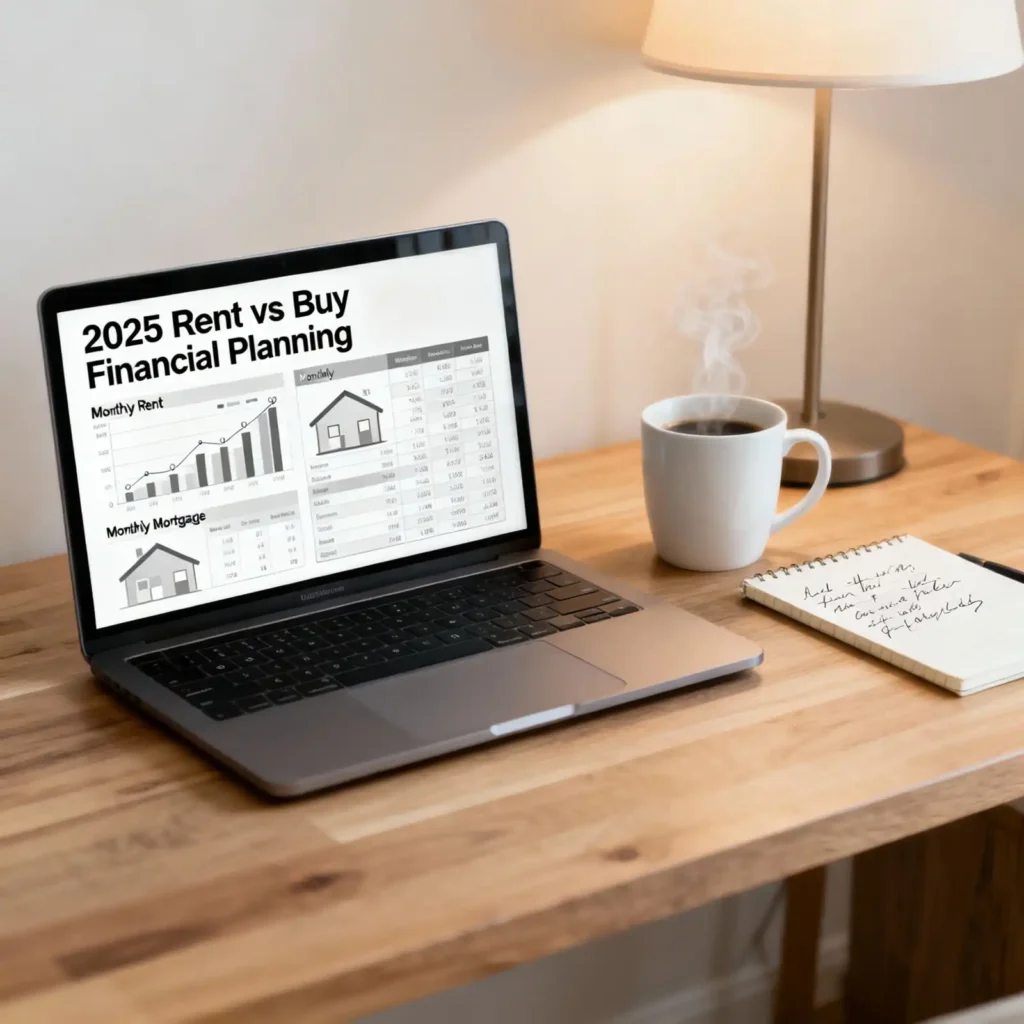
Rent vs Buy Cost Comparison Table
| Scenario | Upfront Costs | Monthly Payment | Annual Outlay | 5-Year Total Cost | Break-even Point (Years) |
|---|---|---|---|---|---|
| Buy: 10% Down | $41,200 + closing | $3,146 | $37,752 | $230,000 | 5.5–6 |
| Buy: 20% Down | $82,400 + closing | $2,770 | $33,240 | $205,500 | 4.8–5.2 |
| Rent | $3,600 deposit | $1,800 | $21,600 | $117,600 | Never (if prices flat) |
Key Variables:
- PMI drops payment if 20% down.
- If mortgage rates fall and you refinance, your break-even shortens.
- Renting offers lease flexibility and avoids maintenance surprises; buying builds equity.
Pro Tip: Use NerdWallet’s rent vs buy calculator for your specifics (location, down payment, tax bracket).
5 Actionable Strategies to Navigate the Crisis
1. Assess Affordability Early
- Check your FICO via annualcreditreport.com. The higher your score, the better your rate.
- Aim for a 20% down payment to avoid costly PMI ($100+/month).
2. Buy Smart
- Explore FHA loans (3.5% down) if you qualify—limits up to $524,255 in most areas, $1.2M+ in high-cost metros.
- Seek out “coming soon” listings, fixer-uppers, or iBuyer deals in states with less inventory pressure (Texas, Florida).
- Act fast: rising construction costs may hit new buyers in 2026 as fewer new homes are built.
3. Rent Strategically
- Negotiate leases in suburban hubs—vacancy rates are up to 1.2% higher, giving you leverage.
- Consider co-living or house-sharing arrangements for 20–30% savings, especially in high-rent metros.
4. Save Aggressively
- Put down payment funds in high-yield savings accounts (4.5%+ APY), and target saving 15% of income monthly.
- Use cash windfalls, side hustles, or inheritance toward your buy fund.
5. Plan for Market Flux
- Expect 1–2 Fed rate cuts in late 2025, which could ease mortgage rates, but don’t count on a crash. Watch for inventory waves in 2026 as aging homeowners eventually list.
The Bigger Picture: Equity, Policy, & Empowerment
The housing crisis is a crossroad of personal finance, public policy, and social change:
- Equity Exposure: 52% of US household wealth is tied to home equity. Volatility in home prices or rates shapes millions’ net worth.
- Market Ripples: If home prices stall or fall, stock market and consumer spending could slow, affecting jobs—just as new Fed and White House policies reach for solutions.
- Policy & Activism: X users rally for “housing as a right,” demand mortgage relief, or propose rent caps. Cities and states race to offer limited fixes as federal aid tapers, meaning the burden—and the power—often remain with individuals willing to hack the system.
- Your Power: Despite market chaos, the steps you take—research, budgeting, negotiation—can carve a path toward stability. Knowledge, not luck, tilts the housing game in your favor.

Frequently Asked Questions (FAQs) – Answering the Big Housing Questions
1. What is the 5% Rule in Rent vs Buy?
The 5% rule is a practical formula to estimate whether renting or buying makes more sense financially. It helps you compare the cost of homeownership to the cost of renting without emotions clouding the math.
Here’s how it works:
If the annual rent is less than 5% of the home’s market value, renting may be more cost-effective. If annual rent exceeds 5%, buying might be smarter long-term.
Formula:
(Annual Rent ÷ Home Value) × 100 = Rent Percentage
For instance, if you’re considering a $400,000 home and similar properties rent for $1,600/month ($19,200/year), the ratio is 4.8%, suggesting renting could be better in 2025’s tight, high-rate market.
This rule includes hidden homeownership costs such as:
- Mortgage interest
- Property taxes (≈1-2% annually)
- Maintenance (≈1% annually)
- Opportunity cost (lost investment yield)
In summary, if total ownership costs exceed your rent by more than 5%, wait before buying—especially in 2025 when mortgage rates hover near 6.5%, and maintenance costs have surged.
2. What Is the Rule of Thumb for Rent vs Buy?
The rule of thumb for renting vs. buying is simple:
- If you plan to stay fewer than 5 years, rent.
- If you plan to stay 5+ years, buy.
That’s because closing costs, maintenance, and market volatility can outweigh the benefits of short-term ownership.
However, the rule of thumb varies in 2025 due to:
- Higher transaction costs (up to 10%)
- Longer breakeven horizons caused by mortgage spikes
- Rent increases averaging 3–4% yearly
Use tools like the NerdWallet or Redfin Rent vs Buy Calculator to personalize your decision according to local prices and inflation expectations.
3. How Much Should You Rent vs Buy for a Home in 2025?
To evaluate affordability, follow the 30-30-40 framework for 2025:
- Spend no more than 30% of your monthly income on housing (rent or mortgage).
- Allocate another 30% to essentials (food, utilities, insurance).
- Save or invest the remaining 40%.
A general comparison:
- Renting: Lower upfront cost (often 1–2 months’ deposit).
- Buying: Large upfront costs (typically 10–20% down + 3–5% closing costs).
Example:
A $400K home with 10% down and a 6.5% interest rate results in ~$3,100/month in ownership costs, whereas a similar property’s rent may average $1,950–$2,200.
If you can invest the difference, renting might be smarter in 2025’s market, according to financial analysis from economists reviewed by U.S. News.
4. Is Owning a Home Really More Cost-Effective Than Renting in 2025?
Not necessarily.
In 2025’s high-interest environment, renting can be temporarily more economical—especially for younger or mobile professionals.
Owning becomes more cost-effective when:
- You plan to stay in the home for 7+ years.
- Home appreciation outpaces maintenance and property taxes.
- You can afford a 20% down payment (to eliminate PMI).
- You lock in a favorable long-term fixed rate.
Conversely, renting can be more efficient when:
- You invest saved funds in 4%+ yielding assets (HYSA, ETFs, etc.)
- You avoid unexpected repair and insurance costs.
- Flexibility matters more than equity (e.g., relocation opportunities).
According to Redfin and NerdWallet’s analysis, 2025 renters in most major U.S. cities save $300–$500 monthly compared to buyers depending on mortgage rates.
5. When to Rent vs Buy a House (At what point does it make sense to renting or buying?)
It makes sense to rent a home when:
- You intend to move within 3–5 years.
- You’re building credit or saving for a larger down payment.
- Your job location is unstable or involves frequent transfers.
- Housing market prices are inflated relative to local rents.
It makes sense to buy when:
- You’re financially stable and ready to commit long-term.
- You have an emergency fund of 6–12 months.
- You’ve achieved a debt‑to‑income ratio below 36%.
- You plan to build equity as part of long-term wealth creation.
In 2025’s economy, many experts recommend delaying purchase until mortgage rates fall below 6%, except for buyers in stable, high-demand regions like Texas, Florida, or parts of the Midwest.
6. Rent vs Buy for Salaried Professionals — What’s More Effective?
For salaried employees, the decision often depends on income predictability and stability of employment.
Buying can be advantageous if you:
- Have consistent income, allowing easy mortgage servicing.
- Qualify for tax deductions on mortgage interest and local taxes.
- Stay in one region for over 5 years.
Renting can be wiser if you:
- Work in tech or corporate sectors with potential layoffs or relocations.
- Want liquidity flexibility—especially for investing excess income.
In 2025, experts suggest salaried professionals in urban hubs—New York, Seattle, and San Francisco—gain better ROI by renting and investing the difference in diversified funds or HYSAs (earning 4.5%+).
7. Rent vs Buy for the Self‑Employed — What’s More Effective?
For entrepreneurs and freelancers, buying can provide:
- Asset security during uncertain income months.
- Tax benefits through mortgage interest and property depreciation.
But renting appeals because:
- It preserves cash flow.
- Avoids high mortgage qualification hurdles amid inconsistent income.
- Helps relocate easily as business needs evolve.
A 2025 affordability analysis by housing researchers found that 54% of self‑employed individuals benefited more from renting—especially those in early business growth stages—than buying under high-interest conditions.
8. Rent vs Buy for Transferable Work or Frequent Relocation
Professionals in transferable jobs (banking, military, IT, or consulting) should prioritize renting for flexibility.
Key advantages of renting:
- Easier relocations every 2–3 years.
- Minimal sunk cost in maintenance or property management.
- Avoids risks of selling in down markets.
Buying may only make sense if:
- You plan to rent out the home later (convert it into an investment property).
- It’s in a high-demand market where resale is quick.
In a mobile workforce era, renting is 70% less stressful operationally and financially, according to a 2025 housing habits survey from QJSSH.
9. Has Anyone Regretted Buying Their First Home Instead of Renting?
Yes—many first-time buyers have expressed regret in surveys, usually due to:
- Underestimating maintenance, tax, and insurance costs.
- Experiencing job changes or relocations shortly after purchase.
- Facing rapidly declining local home values post‑purchase.
A 2025 report by Financial Samurai and Forbes Advisor found almost 38% of first-time homeowners regretted buying too soon, especially millennials.
Common regrets:
- Failing to budget for repairs.
- Overestimating tax benefits.
- Buying before achieving career stability.
Conversely, seasoned buyers with long‑term vision rarely regret purchasing; they benefit from rising equity and stable payments.
10. Rent vs Buy a House — Pros and Cons
| Factor | Renting | Buying |
|---|---|---|
| Upfront Cost | Security deposit (1–2 months) | Down payment (10–20%) + closing costs |
| Flexibility | High — move anytime | Low — commitment to location |
| Equity Growth | None | Builds over time |
| Maintenance | Landlord covers | Owner responsibility |
| Tax Benefits | None | Deductible interest & property taxes |
| Liquidity | High | Limited (locked equity) |
| Market Risk | Minimal | Exposure to property market swings |
11. Buying vs Renting: A Financial Analysis for 2025
Owning offers long-term stability and the security of no rent increases. If the housing market continues growing (forecast +4% per Redfin 2025), ownership acts as a wealth-building hedge against inflation.
However, renting offers more short-term financial resilience. Renters can invest the unused capital for compounded returns while maintaining liquidity.
Financial Takeaway:
- Break-even period: 5–7 years depending on rates, taxes, and appreciation.
- Liquidity matters more than ownership pride in turbulent job markets.
- Renting ≠ Losing; it’s about allocation efficiency—especially in 2025’s economic climate.
12. House Rent vs Buy — The Financial Pros and Cons (Simplified)
Pros of Renting
- Flexibility for career shifts or moves.
- No repair or property tax expenses.
- Frees cash for other investments.
Cons of Renting
- No equity growth.
- Possible annual rent hikes.
- Limited control over living conditions.
Pros of Buying
- Stable housing cost once mortgage is fixed.
- Tangible asset with appreciating value.
- Government‑backed tax benefits.
Cons of Buying
- High initial investment & ongoing expenses.
- Risk of property value decline.
- Reduced mobility in case of job transfers.

13. Is it better to rent or buy in 2025?
There’s no universal answer—run the math using up-to-date calculators. For most urban renters facing $1,800 average monthly payments, buying only makes sense if you have:
- At least 10–20% down,
- Plan to stay 5+ years,
- Can stomach a starter mortgage above $2,800/month.
Homeownership could be a hedge against future rent hikes, but in most markets, your “breakeven” won’t arrive for several years—unless rates or prices fall dramatically.
14. How much do I need for a down payment in 2025?
Aim high: a 20% down payment waives PMI (private mortgage insurance), slashing your monthly bill. On a $412,000 home, that’s $82,400—plus another 3–5% for closing costs. FHA loans allow as little as 3.5% down, but you may pay higher ongoing fees and need a 580+ FICO. Saving in a high-yield account and looking into down payment assistance programs can speed your journey.
15.Will home prices crash in 2026?
Experts see a slow grind rather than a crash. Inventory remains scarce, and demographic demand (millennials and Gen Z aging into buying years) helps keep prices sticky. Redfin predicts a modest 4% price rise through 2025, while inventory growth may not significantly ease until 2026 as more baby boomers list homes. Local price drops can still happen if jobs are lost or new construction surges, but don’t expect national bargains overnight.
16. What if mortgage rates change?
Every 0.25% mortgage rate change can add or subtract more than $100/month from your payment on a median-priced home. Rates could dip by late 2025 if the Fed cuts as anticipated, but locking in a rate you can afford long-term—rather than bridging with risky ARMs—is usually safer.
17. Are there tools to help me decide?
Yes!
- Use the NerdWallet Rent vs Buy Calculator for personalized math.
- Try the First International Bank & Trust Buy vs Rent Calculator for custom scenarios.
- Internal links: Explore our deep dives on budgeting, debt management, and down payment strategies.
Conclusion: Take Action—And Tell Us Your Story
Housing is the single biggest line in most American budgets—often claiming 30–40% of household income. The 2025 market is tough, but not impossible. Whether you’re hustling to save that down payment, negotiating your next lease, or considering a bold move to a new city, your proactive steps and community support matter.
“Will you rent or buy in 2025? Vote below and share your plan!”
CTA: Comment with your rent-or-buy journey—what’s holding you back, or what’s inspiring you? Your real story can help others break free from the housing pressure cooker.