There is a particular kind of pain that only happens at the gas station. It is not dramatic enough to be called tragedy and not small enough to ignore. It is the quiet humiliation of watching the numbers climb while your thumb hovers over the pump like it can negotiate with physics. In April 2026, the national average price for regular gasoline was about $4.04 per gallon, after averaging $3.10 in 2025 and $3.30 in 2024. The pump is not just selling fuel anymore. It is sending a bill for the life we built around the car.
That is why high gas prices feel bigger than gas prices. They behave like an invisible tax on our habits, our commutes, our suburbs, our impatience, and our belief that convenience is the same thing as freedom. We tell ourselves we are paying for transportation, but often we are really paying for distance. We are paying to live far from work, far from stores, far from friends, and then paying again for the machine that makes the distance tolerable.
The Gas Station Heart Attack
The psychological threshold is not a single magic number, but it exists. Households do not rewrite their lives for a ten-cent rise. They twitch. They grumble. They keep going. But once the price gets close to the remembered pain point, behavior changes. Gasoline demand also becomes more responsive when prices rise relative to what people expected, because consumers use recent prices as their reference point. In plain English: when the market punches us hard enough, we stop treating the drive as invisible.
The most important threshold is often the one that feels personal. For many households, $4 per gallon functions like a psychological ceiling because it turns fuel from background noise into a monthly headline. That is not just a gut feeling. AAA’s 2025 survey said interest in buying a fully electric vehicle was at its lowest level since 2019, yet it also noted that when gas prices hit $5 in 2022, many Americans started seriously considering EVs. In other words, pain can move attention even when it does not immediately change the whole system.
And that is the first hard truth here: high gas prices do not automatically kill car dependency. They expose it. They reveal how much of our “choice” was really habit, geography, and inertia wearing a friendly face.
The Data Dive: Are We Actually Driving Less?
If we are being honest, the national picture is messy. Americans are not collectively abandoning driving. In 2024, total U.S. motor-vehicle travel rose to 3,294,031 million vehicle-miles, up from 3,246,817 million in 2023. Average miles traveled per vehicle also slipped a bit, from 11,408 in 2023 to 11,071 in 2024, which suggests the burden is shifting around rather than disappearing. We are not becoming a nation of walking monks; we are still a nation of drivers.
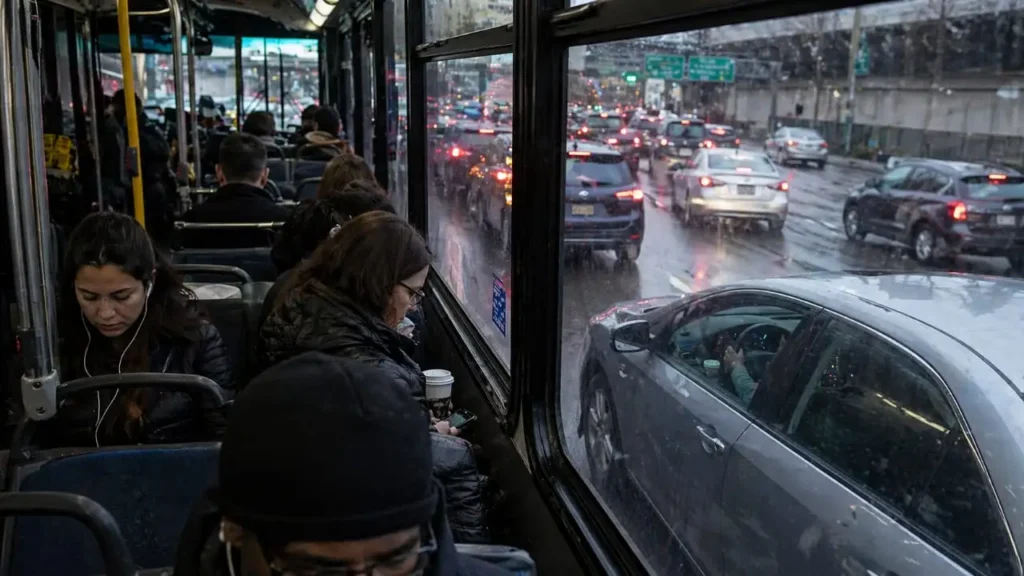
The commuting data says the same thing with more texture. In 2024, the mean one-way travel time to work was 27.2 minutes, up from 26.8 minutes in 2023. About 69.2% of workers drove alone, 13.3% worked from home, and 3.7% used public transportation. The work-from-home share remains more than double its 2019 level, but the drive-alone share is still stubbornly dominant.
So are Americans driving less? Not really, at least not in a clean, nationwide sense. What we are seeing is a split-screen economy. Some people have escaped the daily commute. Some have not. Some households are replacing one car trip with a Zoom call or a bike ride. Others are simply absorbing higher costs and keeping the engine warm. That is the real story: the car dependency machine is bending, not breaking.
There is also the rebound effect, which is economics’ way of reminding us that humans are slippery. When efficiency improves or prices fall, some of the savings come back as more driving. The OECD’s meta-analysis of road transport found a direct rebound effect of about 12% in the short run and 32% in the long run, meaning a chunk of the “savings” leaks back into extra travel. When gas gets cheaper, we do not always bank the difference. Sometimes we just buy more distance.
That matters because it explains why cheap gas never truly solves car dependency. It dulls the pain. It does not cure the addiction.
The Behavioral Economics of the Commute
The commute is where behavioral economics gets ugly. We own a car, then we keep paying for the car, then we keep driving because we already own the car. That is the sunk cost fallacy in a steel shell. The monthly payment is done. The fuel bill is coming. The depreciation is marching in the background like a silent tax auditor. Yet we still tell ourselves the commute is “worth it” because the alternative feels complicated.
Here is the math that ruins the romance. AAA’s 2025 “Your Driving Costs” study found the average new vehicle costs $11,577 a year to own and operate, or 77 cents per mile at 15,000 miles a year. That average includes depreciation, finance charges, fuel, insurance, licensing, registration, and maintenance. In the same study, fuel was only 13 cents per mile on average; depreciation was the monster at 43 cents per mile. The gas pump is loud, but depreciation is the real assassin.
Now imagine a 40-mile round-trip commute, five days a week, 52 weeks a year. That is 10,400 miles just to go to work and come back home. At AAA’s 77-cents-per-mile average, that commute is roughly $8,008 a year in vehicle costs before parking, tolls, or the extra time we lose to traffic. If our employer paid us with a flat-fee sadness package, that would be it.
And yet we normalize this like it is weather.
The real trap is that we do not experience commuting as a bill. We experience it as “just part of life.” That is how bad deals survive: they get folded into identity. The car stops being a purchase and becomes a personality. The commute stops being a cost and becomes a routine. The routine then becomes invisible, which is exactly what makes it so expensive.
The Total Cost of Ownership Reality Check
Gas prices are the visible headline, but ownership cost is the entire newspaper. Here is a five-year comparison using AAA’s 2025 cost data for compact SUVs, which gives us a clean apples-to-apples lens across a gas SUV, a hybrid SUV, and an EV SUV. AAA’s own 2025 analysis says EVs still end up more expensive overall because ownership costs such as depreciation, insurance, and finance charges outweigh some of the savings from cheaper fuel and maintenance.
| Cost category | Gas SUV (annual) | Hybrid SUV (annual) | EV SUV (annual) | Gas SUV (5 years) | Hybrid SUV (5 years) | EV SUV (5 years) |
|---|---|---|---|---|---|---|
| Fuel | $1,714 | $1,348 | $739 | $8,570 | $6,740 | $3,695 |
| Maintenance / repair / tires | $1,746 | $1,491 | $1,449 | $8,730 | $7,455 | $7,245 |
| Depreciation | $3,554 | $3,865 | $4,960 | $17,770 | $19,325 | $24,800 |
| Insurance | $1,726 | $1,771 | $2,028 | $8,630 | $8,855 | $10,140 |
| License / registration / taxes | $641 | $779 | $895 | $3,205 | $3,895 | $4,475 |
| Finance charges | $898 | $1,086 | $1,121 | $4,490 | $5,430 | $5,605 |
| AAA ownership total | $10,279 | $10,340 | $11,191 | $51,395 | $51,700 | $55,955 |
| Mental health tax (illustrative) | $1,250 | $1,250 | $1,250 | $6,250 | $6,250 | $6,250 |
| Total including stress cost | $11,529 | $11,590 | $12,441 | $57,645 | $57,950 | $62,205 |
AAA’s methodology assumes 15,000 miles a year and a five-year ownership period, and the association’s 2025 study reports that regular gasoline averaged $3.151 per gallon in its analysis while electricity for EV charging averaged 16.7 cents per kWh. The numbers above are a model, not a prophecy. The “mental health tax” is our estimate of the hidden cost of time, stress, and cognitive friction; it is not a market price, but it is real enough to live in our bodies. Traffic noise and annoyance have been associated with poor mental health and perceived stress in peer-reviewed research, which is why this line item belongs in the conversation even if nobody itemizes it on a loan statement.
A few things should jump out:
- Fuel is not the main cost. It is the easiest cost to see, not the biggest one.
- The EV is cheaper to “feed,” but not always cheaper to own.
- The hybrid is a compromise, which is exactly why it often looks boring and ends up looking smart.
- Depreciation is the silent gravity well under every shiny car ad.
This is why gas prices can feel like the whole problem while being only one piece of the pain. The pump is the symptom. The ownership model is the disease.
The Zen Finance Connection: Frugality That Feels Like a Peace Dividend
The beautiful thing about driving less is that the win is not just financial. It is psychological. Less driving means fewer decisions, fewer arguments with traffic, fewer repair surprises, fewer parking battles, fewer “I’ll just make one more errand” spirals. Frugality, at its best, is not a punishment. It is a way of buying back attention.
That is where mindfulness enters. Slow driving, done safely and legally, is not about crawling down the highway like a saint in a Subaru. It is about reducing the violence of haste. Smooth acceleration. Modest speeds. Fewer lane changes. Proper tire inflation. Regular maintenance. In other words, we stop treating the road like a courtroom where we must defeat every stranger before lunch. We are not drafting trucks like maniacs; we are simply refusing to burn extra money and cortisol in the name of shaving 90 seconds off a trip. The gains are modest, but so is the point: we are trying to stop leaking energy everywhere.
Carpooling also deserves a better image than the one it has inherited. It is not failure. It is social capital. One ride shared is one less car payment per human, one less parking spot demanded from the city, one less private island of annoyance. In a culture that monetizes isolation, a carpool is a small act of cooperation disguised as logistics.
Then there is the proximity principle, which may be the most underrated money idea in urban life: if work is near home, the car becomes optional rather than tyrannical. This is not glamorous. It is not a hack. It is architecture. The commute gets shorter because the life gets better arranged. That is the real luxury: not a nicer steering wheel, but fewer hours spent surrendering ourselves to it. Census data show the commute question is not trivial in American life; it is a core part of how work, housing, and transportation interact.
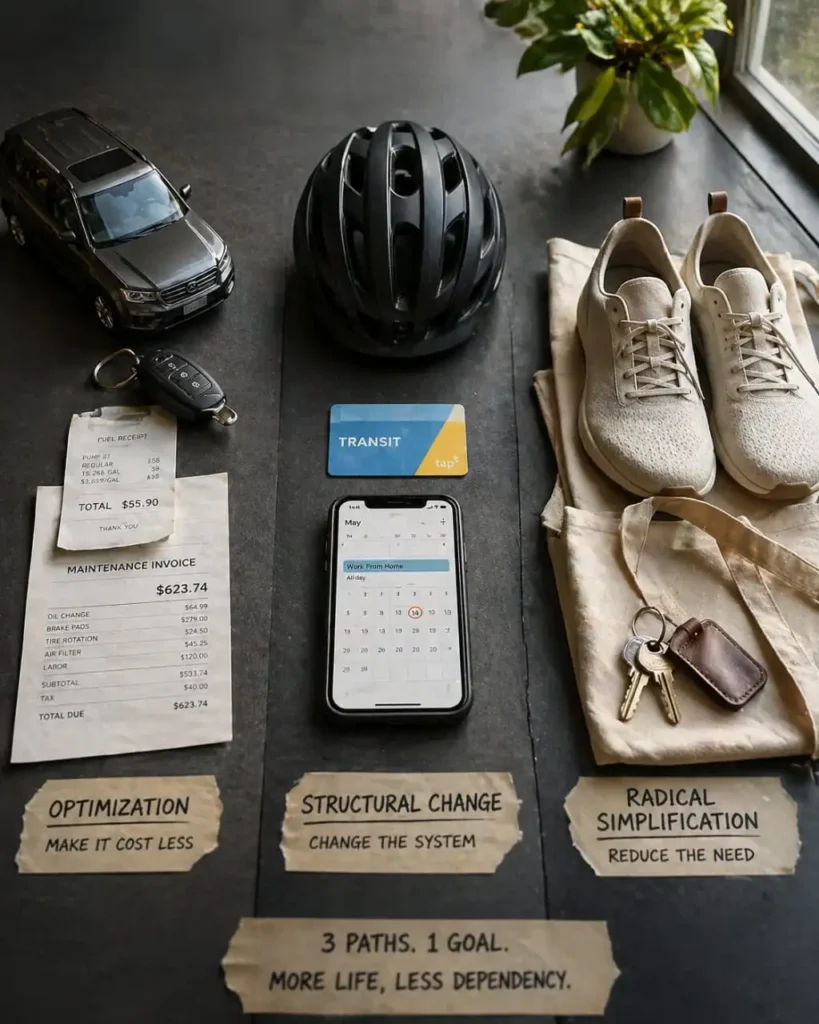
Three Paths Out of the Invisible Tax
1) The Optimization Path
This is for people who need a car and are not pretending otherwise. We are not trying to become saints. We are trying to stop overpaying.
Use this path if:
- your commute is fixed,
- your job is not remote,
- and the car is staying in your life for now.
What helps:
- Keep tires properly inflated.
- Stay on maintenance intervals.
- Avoid aggressive acceleration and hard braking.
- Drive a little slower on highways.
- Remove unnecessary weight from the car.
- Compare insurance every renewal.
- Avoid the “new car because I’m tired of this one” reflex.
TheFitFinance Pro-Tip: the cheapest gallon is the one we never burn. After that, the cheapest gallon is usually the one we burn more gently. The point is not to become obsessed with hypermiling. The point is to stop leaking money through neglect and impatience.
A subtle correction: “drafting” belongs in the same sentence as “unsafe.” Do not tailgate trucks to save fuel. That is not optimization; that is a collision dressed as thrift. Better tires and steady driving are smart. Becoming a weather event behind an eighteen-wheeler is not.
2) The Structural Path
This is where the big savings live because it changes the problem, not just the behavior. If the commute shrinks, the budget breathes.
Use this path if:
- you can negotiate hybrid or remote work,
- you live within reach of transit,
- or an e-bike would cover the first and last mile.
What helps:
- Negotiate two or three remote days a week.
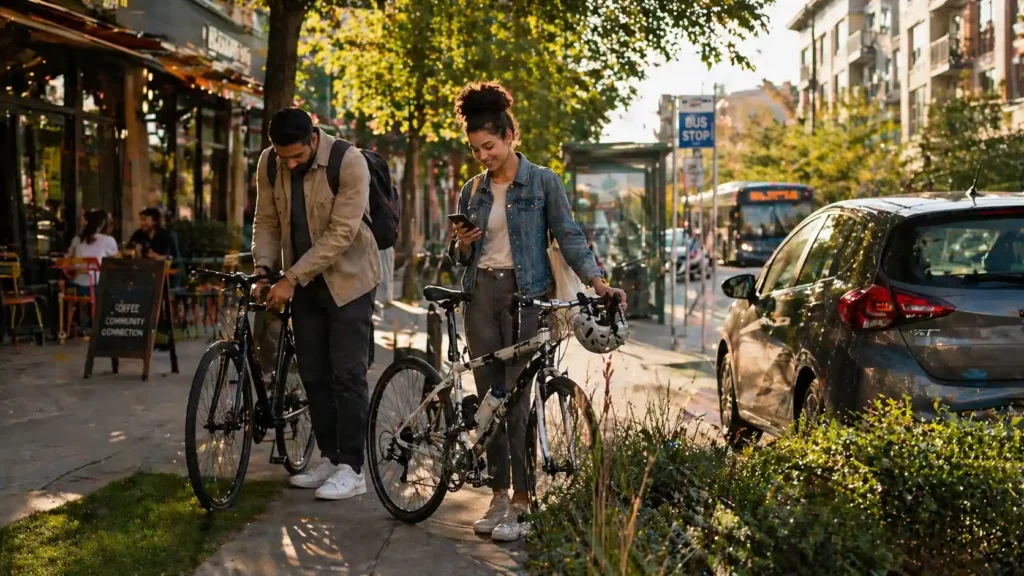
- Test an e-bike for short errands and commuter loops.
- Use public transit for at least one recurring trip so it becomes familiar, not mythical.
- Move one errand cluster per week into a walkable route.
- Think in “transportation stacks,” not single modes.
The Census Bureau shows that 13.3% of U.S. workers worked from home in 2024, while 3.7% used public transportation and 69.2% drove alone. That means the alternatives are not fringe; they are already part of the system, just unevenly distributed. The problem is less “Can we imagine another way?” and more “Can we design our week so another way becomes normal?”
TheFitFinance Pro-Tip: one day a week without the car can be more powerful than seven guilt-ridden trips with it. Structural change beats heroic discipline.
3) The Radical Path
This is the car-light or car-free life. Not for everyone. Not always. But absolutely real.
Use this path if:
- you live in a dense area,
- your work is flexible,
- your second car is mostly a parked object,
- or your family can rewire trips around one shared vehicle.
What helps:
- Sell the most redundant car first.
- Replace short drives with a bike, transit pass, or walking route.
- Bundle trips into one weekly rhythm.
- Build a delivery system for groceries and bulky items.
- Treat the car like a rented convenience, not a personality trait.
The radical path is not about purity. It is about admitting that some of our driving is not transportation. It is habit. When we cut that habit, the monthly budget changes fast because we are removing fixed costs, not just shaving variables. And because AAA’s data show depreciation, finance charges, insurance, and fees are major parts of ownership cost, getting rid of a vehicle can create a larger financial swing than merely buying less gas.
TheFitFinance Pro-Tip: sell the second car before you sell yourself on the idea that “we need both.” Most households do not need two vehicles as much as they need two escape hatches from a difficult routine.
The Financial Cost of Commuting Is Not Just Fuel. It Is a System.
The mistake most people make is simple: they treat commuting as a gas problem. It is not. It is a total cost of car ownership problem wrapped inside a routine. The pump gets all the attention because it is visible, emotional, and paid in the moment. But the real leak is broader: tires wear out, oil gets changed, brakes age, insurance rises, depreciation ticks forward every mile, and the car payment keeps arriving whether we drive 5 miles or 50.
That is why high gas prices and commuting hurt more than a headline suggests. The fuel bill is only the part we can easily see. The deeper cost of car dependency is often a layered mix of fixed costs and variable costs that quietly compound. A person may think they spend $250 a month on gas, but the actual financial cost of commuting can be closer to a second rent payment when depreciation, insurance, maintenance, and financing are counted correctly.
1) The math of misery: opportunity cost in plain English
Opportunity cost is the money we do not get to use elsewhere because it is trapped in a car. That means every commuting mile is not just a mile—it is a trade. It is money not invested, debt not repaid, savings not built, and time not recovered.
A few examples:
- Fuel: easy to measure, easy to obsess over, rarely the biggest cost.
- Tires: every mile lowers tread life, even if the car still “feels fine.”
- Oil and maintenance: small per trip, large over a year.
- Depreciation-per-mile: the silent giant. More miles usually mean lower resale value, and that loss is real whether or not we feel it in the wallet today.
This is why the hidden cost of driving is so deceptive. A commute can look “affordable” because the gas bill seems manageable, while the true cost is spread across many categories and many months. In other words, we are not just paying to move. We are paying for the privilege of using a depreciating asset to save time in a geography that often forces the commute in the first place.
2) Psychological anchoring: why gas feels painful and car payments feel normal
Behavioral economics explains a strange truth: people fixate on the price they see daily and ignore the cost they have already normalized. Gas prices are visible at the pump, so they trigger emotion. The car payment, insurance premium, and depreciation are often mentally filed away as “just life.”
That is anchoring. We anchor to the amount that hurts us in the moment, then ignore the larger structural bill because it is distributed across categories and dates. A sudden jump in fuel can spark immediate gas prices behavior change because it violates our mental reference point. When gas reaches a level we remember as “too high,” like $5.00, the brain finally stops treating driving as frictionless. The commute becomes salient again.
But here is the catch: people do not always change because prices are high. They often change because prices are high and there is a substitute that suddenly feels easier. That means the trigger is not pain alone. It is pain plus an alternative. This is why driving less save money strategies work best when they reduce friction, not just spending.
3) The structural trap: car dependency as a tax on existence
In many places, car dependency in America is not a personal failure. It is a built environment. Housing, work, schools, and shopping were arranged in ways that made driving the default. That turns the car into a toll booth for participating in ordinary life.
This is why the cost of car dependency can resemble a second mortgage. The monthly payment is only one piece. Add insurance, gas, parking, repairs, registration, depreciation, and the time lost to traffic, and the car starts to look less like freedom and more like a recurring subscription to distance.
That matters because the real financial cost of commuting is not just the amount leaving the bank account. It is the shadow cost: stress, lost time, missed flexibility, and a shrinking margin for savings. A family may earn more than another and still feel poorer because car ownership consumes cash flow before it can become resilience.
Key takeaway: the car is not just transportation. For many households, it is a mandatory financial system that taxes proximity, time, and attention.
Financial Checklist: What to Measure Before You Call Driving “Affordable”
- Track your monthly fuel spend for 3 months.
- Add insurance, maintenance, registration, parking, and loan payment.
- Estimate depreciation-per-mile by comparing resale value over time.
- Count commute miles separately from all other driving.
- Measure the time cost of the commute in hours per month.
- Compare the result to the amount you could invest or save instead.
FAQs: The Killer Section – Frequently Asked Questions
1) Why is the total cost of car ownership so much higher than my monthly payment?
Because the monthly payment is only the front door, not the whole house. The true total cost of car ownership includes insurance, maintenance, tires, depreciation, fuel, and fees, and those costs often exceed the loan payment over time. The hidden cost of driving is especially brutal because depreciation hits even when the car sits in the driveway.
Fit Finance Pro-Tip: Build a “car budget” that includes at least five categories, not just payment plus gas. If you only track the loan, you are undercounting the real damage.
2) At what price point do high gas prices and commuting habits actually start to change?
There is no universal number, but behavior usually shifts when fuel crosses a psychological threshold and becomes impossible to ignore. That is where elasticity of demand enters: once driving feels expensive enough, people start combining trips, carpooling, delaying errands, or working from home more often. In many households, the real trigger is not a precise dollar amount—it is the moment commuting costs start competing with rent, groceries, or savings.
Fit Finance Pro-Tip: Watch for behavior changes in your own life, not just national averages. If you start cutting trips or rerouting errands, you have found your personal threshold.
3) How can I reduce driving costs without selling my car today?
Start with three tactical wins: inflate tires properly, remove unnecessary weight from the car, and combine short trips into one route. Next, compare insurance quotes, because many drivers overpay quietly every year. Finally, audit your commute route and speed; smoother driving and fewer hard accelerations can reduce waste more than people expect.
Fit Finance Pro-Tip: Pick one week as a “driving audit” and log every trip. The pattern will usually reveal easy savings you were too busy to notice.
4) Is driving less to save money actually viable in a car-dependent city?
Yes, but often only partially. In a car-dependent city, the goal is usually not to eliminate driving overnight but to shrink the number of required trips and replace short drives with better alternatives. The “last mile” problem is real, which is why e-bikes, transit, rideshares, and mixed-mode commuting matter so much.
Fit Finance Pro-Tip: Do not ask, “Can I go car-free?” Ask, “Which 20% of my trips create 80% of the cost?” That smaller question is usually where the savings live.
5) How do I calculate my personal cost of car dependency?
Use a simple three-step formula. First, add your monthly car payment, insurance, fuel, maintenance, parking, and registration. Second, estimate depreciation by comparing today’s car value with its likely value in a few years, then divide by months. Third, add commute time cost if your time has a clear dollar value, or at least record the hours lost each month.
Fit Finance Pro-Tip: If the total scares you, that is useful information. Shock is often the first honest signal that a budget has been running on autopilot.
The 3-Step Formula to Estimate Your Personal Cost of Car Dependency
- Fixed monthly cost = payment + insurance + parking + registration
- Variable monthly cost = fuel + maintenance + tires + repairs
- Invisible monthly cost = depreciation + lost time + commute stress
Total cost of car dependency = fixed + variable + invisible
That formula is not perfect, but it is powerful because it moves the conversation from “How much do I spend on gas?” to “How much does the car really cost my life?”
Why High Gas Prices Matter Even When They Do Not Solve Everything
This is where the emotional truth and the math meet. High gas prices do not automatically end car dependency, but they do something useful: they make the hidden structure visible. They force us to confront the fact that a car is not a tool we occasionally use. For many of us, it is a second home, a mobile storage unit, and a stress chamber with cupholders.
That is the metaphor we usually miss. Our cars have become expensive living rooms on wheels that we pay to sit in while we are angry at strangers. They are not just transportation devices. They are lifestyle commitments. And because commitments create inertia, we keep feeding them even when the return on the spending is thin.
The good news is that expensive fuel can create honest conversations. Maybe we do not quit driving. Maybe we drive smarter. Maybe we move closer to work. Maybe we stop treating every errand like a separate expedition. Maybe we notice that half of our “mobility” is really unpaid labor for our own schedule.
And maybe, just maybe, we stop calling all this convenience if it leaves us tired, broke, and tense.
The deeper answer to the question in the title is this: high gas prices are not breaking car dependency by themselves, but they are weakening the spell. They are making us see the full invoice. Once we can see the invoice, we can choose differently.
That is the quiet revolution here. Not shame. Not austerity. Just clarity.
And clarity is cheaper than gasoline.
Want the numbers? We used data from AAA, EIA, Census, and EPA to expose the true cost of driving.
Still blaming gas prices? The real expense may be sitting in your driveway.
👉 Explore our Car Ownership Cost Calculator and uncover the hidden numbers.