
Turn your solo savings into shared success—start your married life with a money plan.
> Shocking: 28% of couples consider hiding money or debt as bad as cheating. Just imagine: you are back from your honeymoon, excited to file joint taxes… and then you discover your spouse is carrying a secret credit card mountain. In our experience at TheFitFinance, that moment of shock can set the tone for marriage – if it happens at all. But it does not have to. By the end of this guide, you will have a step-by-step roadmap to master premarital financial planning. You will learn to inventory your finances, draft a shared budget, and even handle tricky issues like prenups and student loans—so the only surprises on your first tax return are deductions, not debts.
Why Single-Person Financial Planning for Marriage Matters
Building a life together isn’t just about merging closets – it’s about merging wallets too. Every year, countless couples hit roadblocks because they skipped premarital financial planning. In fact, nearly half of partners report arguing about money occasionally, and “financial infidelity” (like hidden debt) ranks right up there with betrayal. As financial counselor Rahkim Sabree warns, “Money is one of the top reasons for divorce… If there is a difference in values, beliefs and behaviors around money, it creates a recipe for disaster.”.
- Open secrets early. A Bankrate study found 42% of couples keep a financial secret. Many are embarrassed to admit debts or spending habits. But imagine postponing that reveal until after you say “I do.” In community-property states (like California or Texas), one spouse’s debts can legally become the other’s problem. Don’t wait for marriage papers; make it safe to share now.
- Connect your goals. Financial planning is like a two-person GPS. One partner might be saving for a down payment, the other dreaming of a round-the-world honeymoon. Discussing goals upfront creates a shared vision. It keeps both of you pulling in the same direction instead of drifting apart.
- Build trust and teamwork. Joint budgeting isn’t romantic, but it’s a team-building exercise. When each partner sees the other’s income, debts, and savings, you’re essentially getting to know each other’s financial personality. According to experts, sharing debts (credit cards, student loans, mortgages, etc.) and even doing a joint credit report review can cut future stress.

Before the wedding timeline gets crowded, the money conversation needs space.
Case in point: When CPA Rachel’s friend opened joint accounts after marriage without a financial discussion, she was shocked by unpaid bills and hidden loans. Avoid that fate: schedule a “money date” now!
Imagine starting marriage with clarity instead of conflict. That’s the power of premarital financial planning. You will not only avoid nasty surprises, you will build a financial foundation for every dream (house, kids, early retirement) ahead.
How to Kick Off Your Premarital Financial Plan – Step by Step
Think of your premarital planning as building a map of your finances. It starts with transparency and organization. Here’s how to begin:
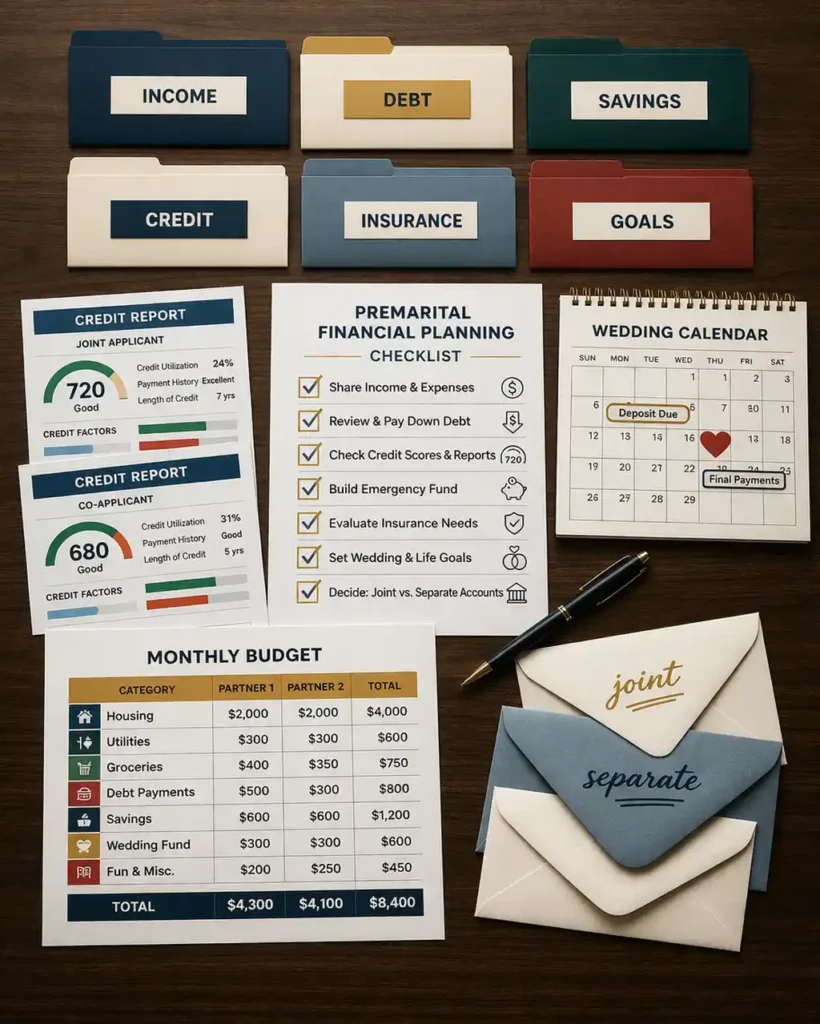
- Inventory Everything: List all assets and debts each partner has. This includes bank accounts, 401(k)s, real estate, jewelry, investments – and liabilities like credit cards, student loans, car loans, mortgages, personal loans, taxes owed, etc.. (Yes, everything.) Write down balances, interest rates, and terms. Don’t skimp on detail – even small debts can add up.
- Check Your Credit Scores: Pull your free credit reports from AnnualCreditReport.com with your partner (it’s free once per year from each bureau). Compare scores and talk through any blemishes. Couples who know each other’s credit can plan to improve it together. A big score gap might even shape future decisions, like who will apply for loans.
- Discuss Income and Paychecks: Share your take-home pay (after taxes and deductions). If one income is much higher, will your budget rely on one person? Decide how to divide essentials vs. fun spending. Bankrate suggests applying rules like “50/30/20” across combined income and tracking it in one account. For example, 50% on needs, 30% wants, 20% savings, together.
- Detail Current Expenses: Both of you should list monthly expenses (rent, utilities, groceries, insurance, subscriptions, debt payments, etc.) and how much you save or invest. Compare notes – you might find one is overspending on takeout while the other is hoarding cash. Honest budgeting now prevents resentment later.
By now, you’ve created a clear “financial starting line.” You each know who is bringing what, and you’ve aligned your money goals. If this feels overwhelming, remember: this is exactly like charting a course. The clearer your map, the easier the journey.

What to Consider Before Tying the Knot
Visualize sharing your future by planning it. Premarital financial planning is like setting a GPS for your marriage: it prevents you from getting lost.
Essential Financial Questions to Ask With Your Partner Before Money Becomes a Problem
Joint, Separate, or Hybrid? Managing Accounts and Money Roles
One big decision: Will you merge finances or keep them separate? There’s no one-size-fits-all answer, but following a plan helps:
- Joint Accounts: Many experts (and proud newlyweds) open a joint account for shared expenses (rent/mortgage, groceries, utilities). City National Bank notes that if neither of you had significant wealth going into marriage, combining accounts can symbolize partnership and streamline bills. Picture combining two rivers into one strong stream.
- Separate Accounts: If one partner has major assets (say, a house or investment portfolio) or debts, you might keep some money separate. This is common in second marriages or when children from prior families are involved. For example, Mark (see Case Study below) will earmark his inheritance for his daughter from his first marriage, while contributing fairly to new joint expenses.
- Hybrid Approach: You could share one joint account for bills and savings, but keep individual accounts for personal spending. This gives everyone freedom while maintaining teamwork. Just agree on how much each contributes to the joint account.
Quick Self-Audit:
- Do we agree on splitting rent, groceries, and utilities?
- Are both of us comfortable with one partner contributing more because of income differences?
- If one has much higher debt, should we adjust contributions until it’s paid down?
Discussing accounts dovetails into one of the biggest premarital tasks: deciding on a prenuptial (premarital) agreement. A prenup often gets a bad rap, but it’s essentially a financial roadmap drawn before marriage, not a sign you expect divorce. Attorneys say the process forces transparency and can actually strengthen trust. For example, your prenup can clarify that your small savings account or 401(k) stays yours if things go south. If you choose a prenup, start it well before the wedding – waiting until the last minute invites arguments and legal risk.
Case Study – Sarah’s Approach: Sarah and her fiancé both agreed to open a joint savings account labeled “Wedding + Future House.” Every month, each deposits 10% of their paychecks into this account before deciding how to spend the rest. They also maintain separate checking accounts for personal spending money. This hybrid system lets them share big goals (like a new home down payment) while keeping autonomy on small buys.
Planning for Life’s Big Milestones – Kids, Career, and Home
Your premarital plan isn’t just about today; it’s about 5, 10, 20 years down the road. Bring out your crystal ball (or use bullet points) and talk through major events:
- Kids and Family: The cost of raising kids is huge – Bankrate cites an average of ~$313,000 per child through age 17. Before marriage, ask how many kids do we want, and when? Do we plan to fund private school or college? If one of you plans to stay home, will your budget adjust to one income? These questions frame important saving and insurance decisions.
- Career Moves: Are promotions or job changes on the horizon for either of you? A sales commission job may fluctuate, so plan how shortfalls will be handled. Discuss relocation: will one spouse move for the other’s dream job? If so, do we have a financial cushion? Think five-year goals: Do we each expect raises, or additional education (like an MBA) that requires paying tuition or taking student loans?
- Housing: Talk about where you want to live. Do you dream of city life with a high rent but great career growth, or a suburban home with a yard? Use online tools to compare median incomes and home prices in both areas. If one of you already owns a home, decide whether to keep it as a rental/investment or sell it when you marry. For renters, figure out how much to save for a down payment on the next house. (Hint: some banks allow first-time homebuyer programs that you can prepare for.)
- Retirement Planning: Yes, even before marriage! Are you both on track for retirement? Check your current savings rates. It’s easier to adjust contributions now than scramble later. If you both have 401(k)s or IRAs, discuss whether you’ll keep those separate or coordinate how to reach your shared retirement vision (early retire on a farm? Travel the world?).
By addressing the “big questions” early, you align on life goals. It’s like plotting stops on a road trip: you won’t wander off course.
Building Your Budget Blueprint – Step by Step
With all goals and numbers laid out, it’s time to build a joint budget. Think of this as the “marriage GPS instructions” for your money. Here’s a framework:
- Step 1: Track Your Combined Cash Flow. Add both incomes, subtract taxes. Then list all monthly fixed expenses (mortgage/rent, utilities, insurance, loan payments) and variable spending (food, gas, entertainment). Don’t forget periodic expenses like car registration or holiday gifts.
- Step 2: Set Savings Goals. Decide what you’re saving for and how much each month. This might be a wedding/honeymoon fund (if not already at $33,000+ which is the 2024 average!), emergency fund, home down payment, retirement, etc. Many financial planners recommend saving at least 10% of your combined income—some even suggest a minimum 10% to a tax-advantaged account as a starting rule.
- Step 3: Build Discretionary Spending. With essentials and savings set, see what’s left for fun (dining out, Netflix, gym, hobbies). Give each other a reasonable allowance so neither feels deprived or overspending. Some couples agree on a “date night budget” and a “surprise fund.”
- Step 4: Automate and Track. Automation is your friend. Set up automatic transfers to savings right after payday. Consider using one joint budgeting app or spreadsheet where both can update expenses. 50/30/20 budgets (needs/wants/savings) work, but tailor it to your lifestyle. The key is that you both understand where every dollar is going.
By doing this exercise before marriage, you’re treating your future family budget like a project—because it is. This avoids the classic pitfall of going overboard on wedding costs and neglecting the bigger picture. (Tip: According to Zola, a wedding averages ~$33,000 in 2024, so budget wisely rather than charging it all.) Your budget blueprint should be a living document. Expect to revisit it after major events (new baby, job change) and adjust accordingly.
Protecting Your Hard Work: Insurance and Legal Safety Nets
Just as you schedule car maintenance, you need to protect your financial plan from life’s breakdowns. Insurance and estate planning are not romantic, but they are essential:
- Emergency Fund: Aim to build a joint fund covering 3–6 months of combined living expenses. Start small if you need, but do start. This fund is your first defense against job loss, medical bills, or that surprise car repair (because cars break, and sometimes at midnight). Use a high-yield savings account or money market so it’s liquid.
- Life Insurance: If one of you were to pass away, the other should not be crushed by lost income or lingering debts. Bankrate advises that life insurance should be part of your discussion before marriage. If you plan children soon, consider term life policies on each other to cover income replacement. Reassess amounts whenever you have a new family member.
- Health and Disability Insurance: Being engaged may change your health insurance options (one spouse might cover the other). Also discuss what would happen if one of you becomes unable to work. If neither of you has strong coverage through work, look into disability insurance or supplemental health policies so illness/injury doesn’t wipe out your savings.
- Estate Documents: Even if you marry soon, having basic documents as a single person is critical. These include a will, durable power of attorney (financial), healthcare proxy, and living will. A will ensures any assets you currently have go where you want (either to each other or to your families of origin). Durable POA/healthcare proxy allow each of you to make decisions if the other is incapacitated. Think of these as bedside and business-signed authority – they’re your voice when you can’t speak.
- Prenuptial Agreement (if applicable): If either partner has significant assets, debts, or children from a prior relationship, a prenup can clarify what’s communal and what stays separate. It’s not just for the ultra-rich; many experts see it as a communication tool. Consider it a careful conversation about protecting each other’s well-being, not a vote of no confidence.
Investing time now in these protections is like buying insurance on your dreams. Yes, they can feel awkward to discuss – but compare that to the nightmare of being widowed or suing each other over a forgotten loan. Schedule a meeting with a lawyer or financial counselor if needed. As one expert bluntly notes: “Not being honest about your financial situation can range from disappointment and broken trust to divorce.”
Meet Two Couples: Case Studies in Premarital Planning
Case Study: Sarah from Ohio – Balancing Loans and a $30K Wedding
Sarah (29): Works in marketing, income $55,000/year. Has $25,000 in student loan debt and $5,000 in credit card debt. $3,000 in savings. Fiancé Mike (31): Accountant, income $65,000. He has no debt and $10,000 saved for a house down payment.
Challenge: Sarah and Mike plan a wedding in 9 months. They want to buy a home in 2 years. But Sarah worries about her debt, and Mike doesn’t want to be held back by it.
Plan of Action:
- Debt Transparency: At their first “money date,” Sarah admitted her debts. They listed them together and agreed Mike would help create a payoff plan. They decided to pay extra on the credit card debt aggressively (higher interest) while making student loan minimums.
- Joint Budget: They opened a wedding savings account. Each will deposit $500 per month until the wedding (totaling $9,000 after 9 months). They trimmed wedding costs by DIYing invitations and negotiating with vendors.
- Savings and Goals: After the wedding, they plan to redirect the $500 each to a house fund. They set a 3-year goal to save $40,000 for a down payment. They also pledged to save 10% of each paycheck into retirement (split between 401(k)s).
- Accounts: They keep separate checking accounts for personal expenses (to allow splurges like a streaming service or weekend gadget), but all essential bills and savings go through joint accounts. This satisfies Sarah’s need for financial control and Mike’s desire for teamwork.
Result: By wedding time, Sarah’s credit card is paid off. Mike helped her draft a simple prenup (even though it felt awkward) to protect her savings and any inheritance for children. Having this conversation actually reassured Sarah that Mike is committed. The budgeting process also showed Mike how much Sarah was spending on student loans; together they now feel empowered to tackle it.
Case Study: Mark from Texas – Second Marriage with Kids, Protecting Assets
Mark (45): CEO of a small business, income $150,000/year. Owns a home ($300,000 value) and business ($250,000). Has a 10-year-old daughter from a previous marriage. $150,000 liquid savings.
Jenna (40): Nurse, income $80,000. Has $40,000 in student loans and $5,000 in credit card debt. No kids.
Challenge: Mark and Jenna are engaged. Mark needs to ensure his daughter’s inheritance isn’t compromised, and both need to handle Jenna’s loans.
Plan of Action:
- Legal Protections: They agreed a prenup was wise. They hired separate attorneys. In that process, Mark disclosed his assets (business, home) and Jenna disclosed her finances (loans, checking account balances).
- Prenuptial Agreement: The prenup (all signed 6 months before marriage) stipulates that Mark’s business and home remain separate property. If divorce occurs, Jenna waives claim to the business (though she can apply to be employed by it). Both waived spousal maintenance beyond a short term. They also agreed that existing debts (Mark’s credit card debt and Jenna’s student loans) remain with the person who incurred them.
- Joint Savings Plan: Instead of commingling assets, they agreed to allocate specific joint savings goals. Each will contribute $1,000 monthly to a joint investment account earmarked for a 529 college fund for Mark’s daughter and a rainy-day fund for the new family.
- Insurance and Estate: Both updated their wills. Mark added a clause leaving a trust for his daughter with Jenna as trustee (per the prenup’s estate plan alignment). They each took life insurance policies naming the other as primary beneficiary (to cover lost income if one died).
Result: Mark and Jenna started marriage feeling secure: Jenna respects Mark’s responsibility to his daughter, and Mark knows Jenna won’t face his business debts. Financially, they both commit to paying down Jenna’s loans; Mark’s higher income lets them do an extra $500/month on student debt and still save aggressively. Their prenup conversation also doubled as a deep dive on values – for example, Jenna discovered Mark’s careful habits from childhood, which eased her worry about overspending.
Common Mistakes to Avoid in Premarital Planning
Knowing what to do is half the battle; knowing what not to do can save you even more grief. Here are some classic pitfalls:
- Mistake: “We’ll handle money after the wedding.”
Dodge It: Treat marriage like a joint venture, not a surprise party. Schedule a first “money date” (ideally with dinner and no phone) to go over finances well before the wedding. Waiting until after the honeymoon leaves no room to address credit failures or debts. In fact, one CPA warns that starting joint accounts too early can backfire if credit is bad. - Mistake: Keeping secrets or sugar-coating debt.
Dodge It: Transparency is a gift, not a gift-wrapping of lies. Hiding credit cards or debt guarantees a future argument. Studies show secret debt often leads to broken trust. The best time to reveal that car loan or that shopping binge is now, not when you’re already married. - Mistake: No budget for the wedding (or honeymoon).
Dodge It: The wedding is expensive, but it shouldn’t bankrupt your future. Draw up a wedding budget: allocate a max for venue, attire, rings, etc., and stick to it. Consider delaying the wedding if you need more time to save – a longer engagement can reduce financial stress. For example, if you know wedding costs ~$33K, build a timeline to save that amount at comfortable monthly contributions. Treat the wedding fund like any other goal in your joint budget. - Mistake: Assuming marriage erases individual credit history issues.
Dodge It: Marriage doesn’t scrub away bad credit. If one partner has a low credit score, that debt or late payments still affect you — especially in community property states. You might have thought of filing taxes jointly, but consider whether separate filing maintains income-driven loan payments, or how joint credit applications might hinge on that 600-credit-score reality. Have a strategy: either improve credit now (spend less, pay bills on time) or plan finances with dual perspectives. - Mistake: Ignoring the estate plan and beneficiaries.
Dodge It: Even if you haven’t said “I do,” don’t skip basic legal work. If you die intestate (without a will), state law could leave assets to your blood relatives, not your fiancé(e). At the very least, each of you should name each other (or other loved ones) as beneficiaries on retirement accounts and life insurance, and execute a simple will. This is especially important if you don’t plan a full prenup. - Mistake: Not considering children and future dependents.
Dodge It: If kids might be on the horizon, talk about how you’ll pay for daycare, college, or whether one of you will stay home. For example, who covers childcare costs? Is one of you willing to become a part-time parent? Discuss these now, because they’ll have massive financial and emotional impacts later.
Avoiding these pitfalls is as important as following the right steps. Think of them as speed bumps on your marriage highway: slow down and plan, rather than crashing over them.

Clarity feels a lot like peace.
FAQs about Premarital Financial Planning
Q: What is premarital financial planning?
A: Premarital financial planning means talking through and organizing your finances before you get married. It includes disclosing debts, assets, and credit scores; setting combined budgets and savings goals; and discussing big decisions like prenuptial agreements, children, and home buying. In short, it’s treating your upcoming marriage like a joint financial venture.
Q: Why should I do premarital financial planning if we trust each other?
A: Trust is great, but transparency is better. Even the most in-love couples fight when money surprises happen. As we’ve seen, many adults hide finances out of embarrassment (42% keep financial secrets!). Premarital planning is less about mistrust and more about preventing unknown unknowns. It’s like buying insurance on your marriage’s future – you expect it never to be needed, but you’ll be grateful if it saves you from conflict.
Q: When should we start premarital financial planning?
A: Yesterday! But realistically, as soon as you and your partner are engaged or considering marriage. Some experts suggest having the first money talk 6-12 months before the wedding. That said, it’s never too late – even a month of planning can help. Don’t postpone it till the wedding countdown is on; early planning reduces stress and gives you time to fix issues (like improving credit scores or saving more).
Q: What topics should couples discuss before marriage?
A: A lot, but the crucial ones are:
- Finances: incomes, debts, expenses, savings rate, credit scores.
- Goals: Career plans, kids, homeownership, retirement age.
- Money Habits: Are you savers or spenders? How was money handled in your families?
- Legal: Do you need a prenup? What about wills and insurance?
It might feel awkward, but these “taboo” topics prevent drama. We recommend scheduling a couple of “money dates” (maybe over coffee or dinner) to go through a checklist of questions. For example, “How much debt do we each bring?” and “How do we split bills?”
Q: What are the advantages and disadvantages of premarital financial planning?
A: The advantages include avoiding surprises, sharing goals, and strengthening teamwork. Couples who plan together are more likely to avoid money-related conflicts. It also helps build a budget and savings strategy, so you can start married life without financial uncertainty. The main “disadvantage” is the initial discomfort: talking about money can feel unromantic or tense at first. But think of it as weeding a garden: a bit unpleasant now saves you from bigger troubles later. There is no financial downside to knowing each other’s situation.
Q: Do we have to combine accounts to succeed in marriage?
A: Not necessarily. Some couples find that joint accounts foster unity and trust, while others prefer keeping separate “personal” accounts for individual spending. It’s a personal choice. What matters is that you agree on a system. If you keep things separate, plan how to share joint bills fairly. If you go joint, maintain clear records. Many couples choose a hybrid – one joint account for necessities and individual accounts for personal expenses. The key is clear communication and mutual agreement on whichever setup you choose.
Q: Is a prenuptial agreement really necessary?
A: Not for everyone, but consider it like a safety net. If one partner has substantial pre-marriage assets (like a business or inheritance) or significantly more debt, a prenup can clearly outline who gets what in case of divorce or death. Importantly, going through the prenup process means full financial disclosure and honest discussion – which can boost trust. It may seem unromantic, but many couples find the peace of mind it brings outweighs the stigma. At minimum, know your state’s rules: without a prenup, property is divided either by “community property” or “equitable distribution,” which might not match your wishes.
Q: What happens to debt after marriage?
A: It depends. If you marry in a community-property state, debts incurred during marriage (and sometimes before) can become joint responsibilities. Even in other states, one spouse’s debt can affect joint credit applications. It’s crucial to decide how you’ll handle existing debt: Will you tackle it together or separately? Will you co-sign new loans or keep them in one name? Discuss these scenarios – for example, Bankrate notes that when applying for an FHA or VA loan, lenders will count both spouses’ debts in community states. Planning this now can improve your chances for a mortgage later.
Action Time & Next Steps
You’ve just charted a course through the maze of premarital finances. The ultimate takeaway? Premarital financial planning turns “I do” into “we can.” By facing the tough topics before marriage, you replace uncertainty with a shared action plan. Think of it as laying a solid foundation for your financial future, brick by careful brick. Now, go put these steps into practice. Start with a “money date,” list those debts, open that joint savings pot, and give yourselves a high-five for doing the hard work.
You’ve got this. The success of your marriage is built on more than love alone—financial harmony helps keep it sweet. Now that your budget is set and your emergency fund is on track, your next step is protecting it. Check out our guide on estate planning for couples to ensure nothing derails your plans.
What’s the first money topic you’ll tackle with your partner? Drop a comment below. Join TheFitFinance newsletter for more tips, and let’s keep the conversation going — because a strong financial partnership starts with a single conversation.